

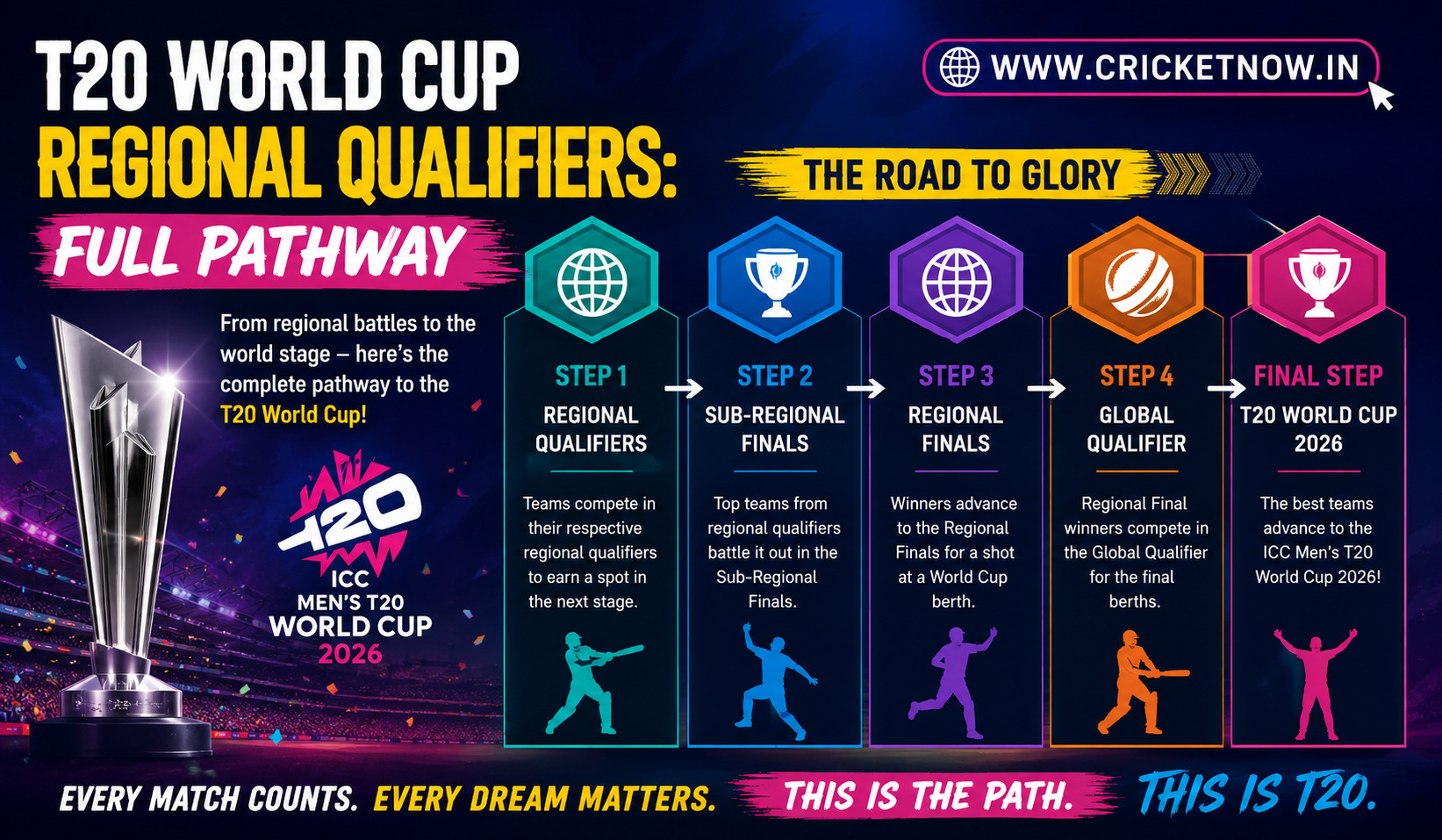
Twelve teams already have their tickets punched for the 2028 Men’s T20 World Cup in Australia and New Zealand. The other eight spots are being fought for right now, across five continents, in a qualification structure the ICC only finalized in July 2026. If you have lost track of how the ICC T20 World Cup regional qualifiers actually connect to each other, here is the entire pathway laid out in order.
The New 2028 Format at a Glance
The 2028 tournament keeps the 20-team field used in 2026, split into four groups of five in a single round-robin group stage, before the top teams advance to a Super Eight round, semi-finals, and the final. What changed in July 2026 is not the tournament itself but how teams get there. The ICC reintroduced a Global Qualifier stage that had been dropped from the pathway since 2022, adding an extra layer of jeopardy for teams sitting just outside the automatic qualification zone.
Teams Already Qualified for 2028
Hosts and Super Eight Qualifiers
Co-hosts Australia and New Zealand qualify automatically, as tournament hosts always do. Joining them are the seven teams that reached the Super Eight stage of the 2026 T20 World Cup in India and Sri Lanka: England, India, Pakistan, South Africa, Sri Lanka, the West Indies, and Zimbabwe.
Rankings-Based Direct Entries
The remaining three automatic places went to the next best-ranked sides in the ICC Men’s T20I Team Rankings as of March 9, 2026, among teams that had not already reached the Super Eight. Those places went to Afghanistan, Bangladesh, and Ireland. Combined with the hosts and the Super Eight teams, that locks in 12 of the 20 spots at the tournament well over two years before a ball is bowled.
The Global Qualifier Explained
The remaining eight World Cup spots will be decided through a 16-team Global Qualifier, and getting into that 16-team field happens in two very different ways.
Eight of those 16 slots go automatically to teams that competed at the 2026 T20 World Cup but did not secure direct qualification for 2028: Canada, Italy, Namibia, Nepal, Netherlands, Oman, the United Arab Emirates, and the United States. Having played on the big stage in 2026 earns these sides a bye straight into the Global Qualifier without needing to survive a regional bracket first.
The other eight Global Qualifier places are won on the ground, through five separate regional qualification pathways covering Africa, the Americas, Asia, Europe, and the East Asia-Pacific region. Once the 16-team Global Qualifier is complete, the highest-placed team from each of the five regions earns a World Cup spot, and the next three best-performing teams overall, regardless of region, take the remaining three places, subject to what the ICC calls minimum performance criteria.
Regional Qualifier Pathway and Schedule
Each region is running its own multi-stage bracket through 2026 and into 2027, funnelling dozens of nations down to a handful of Global Qualifier spots. Here is how each one is shaping up.
Europe Qualifiers
Europe is running its biggest qualification push yet, spreading 30 competing nations across three separate events in 2026. Qualifier A took place in Cyprus from May 16 to 23, featuring Austria, Croatia, Cyprus, France, Guernsey, Jersey, Malta, Slovenia, Sweden, and Switzerland. Qualifier B is scheduled in Denmark from July 8 to 15, involving Belgium, Denmark, Estonia, Gibraltar, Hungary, Norway, Romania, Scotland, Serbia, and Türkiye. Qualifier C follows in Finland from August 14 to 21. The top-performing sides from these three events progress toward the Europe Regional Final, where two spots in the Global Qualifier are ultimately on offer.
Africa Qualifiers
Africa’s pathway runs through several sub-regional groupings before narrowing to a continental qualifier. One confirmed grouping brings together Tanzania, Ghana, Eswatini, Malawi, Seychelles, and Saint Helena, while a separate group features Gambia, Lesotho, Mozambique, Nigeria, Uganda, and Zambia. The strongest sides from these sub-regional events advance to the main Africa Regional Qualifier, joining Namibia, which already holds an automatic Global Qualifier place from its 2026 World Cup participation. Two spots in the Global Qualifier are available from the African region overall.
Americas Qualifiers
The Americas region is working through sub-regional groups as well, with one notable event, Sub-Regional Qualifier B, staged in the Cayman Islands from March 8 to 15, 2026, contested by Argentina, Mexico, Suriname, and the Cayman Islands in a double round-robin format. The winner advances toward the main Americas Qualifier, expected in 2027, competing for a single Global Qualifier place. Canada and the United States, both 2026 World Cup participants, already hold their Global Qualifier spots regardless of how this regional bracket plays out.
Asia and East Asia-Pacific Qualifiers
These two regions have historically run a combined qualifying event, and early action for 2028 has already taken place. The East Asia-Pacific Sub-regional Qualifier was hosted by Japan from May 8 to 18, 2026, featuring nine teams including Cook Islands, Fiji, Indonesia, Japan, Papua New Guinea, the Philippines, Samoa, South Korea, and Vanuatu, with the top two from each of three groups advancing to a Super Six stage. Papua New Guinea won the tournament, with Japan as runners-up. Combined, the Asia and East Asia-Pacific regions have three Global Qualifier spots to fill, with Nepal, Oman, and the UAE from Asia already holding automatic Global Qualifier places as 2026 World Cup participants.
How Teams Reach the World Cup From Here
Putting the whole ladder together, a team without an automatic 2026-based entry needs to survive three separate stages to reach the 2028 World Cup:
- Win through sub-regional qualifying events within its region
- Progress through that region’s full Regional Qualifier to become the top regional finisher, or place well enough to be considered among the next three best overall
- Perform strongly enough in the 16-team Global Qualifier itself to claim one of the eight remaining World Cup places
It is a genuinely demanding gauntlet, and it means an emerging nation like the Cayman Islands or Saint Helena is still, realistically, three tournaments away from a place at a men’s T20 World Cup. Compare it to European football qualifying, where a small nation has to survive a qualifying group before even reaching a playoff round, except here the whole process spans continents and roughly two full years.
Key Dates to Track
Several regional events are still without confirmed dates as of mid-2026, particularly some Africa sub-regional groupings and the full Americas Qualifier, which is expected to land sometime in 2027. The Global Qualifier itself has not yet had its dates or host confirmed publicly. Fans following any single Associate nation’s path should expect the picture to sharpen considerably once the Europe qualifiers wrap in Finland this August and the Americas sub-regional events move into their next phase.
Frequently Asked Questions
How many teams will play at the 2028 T20 World Cup?
The tournament will keep its 20-team format, the same size used for the 2026 edition in India and Sri Lanka.
Which teams have already qualified for 2028?
Australia and New Zealand as hosts, England, India, Pakistan, South Africa, Sri Lanka, the West Indies, and Zimbabwe from the 2026 Super Eight, and Afghanistan, Bangladesh, and Ireland through T20I rankings, for 12 teams total.
What is the Global Qualifier in this new pathway?
It is a 16-team event that decides the tournament’s final eight spots, combining eight teams that automatically advance from the 2026 World Cup with eight teams that earn their place through regional qualifying.
How many spots does each region get in the Global Qualifier?
Two spots each from Africa and Europe, two combined from Asia and the East Asia-Pacific region, and one from the Americas.