

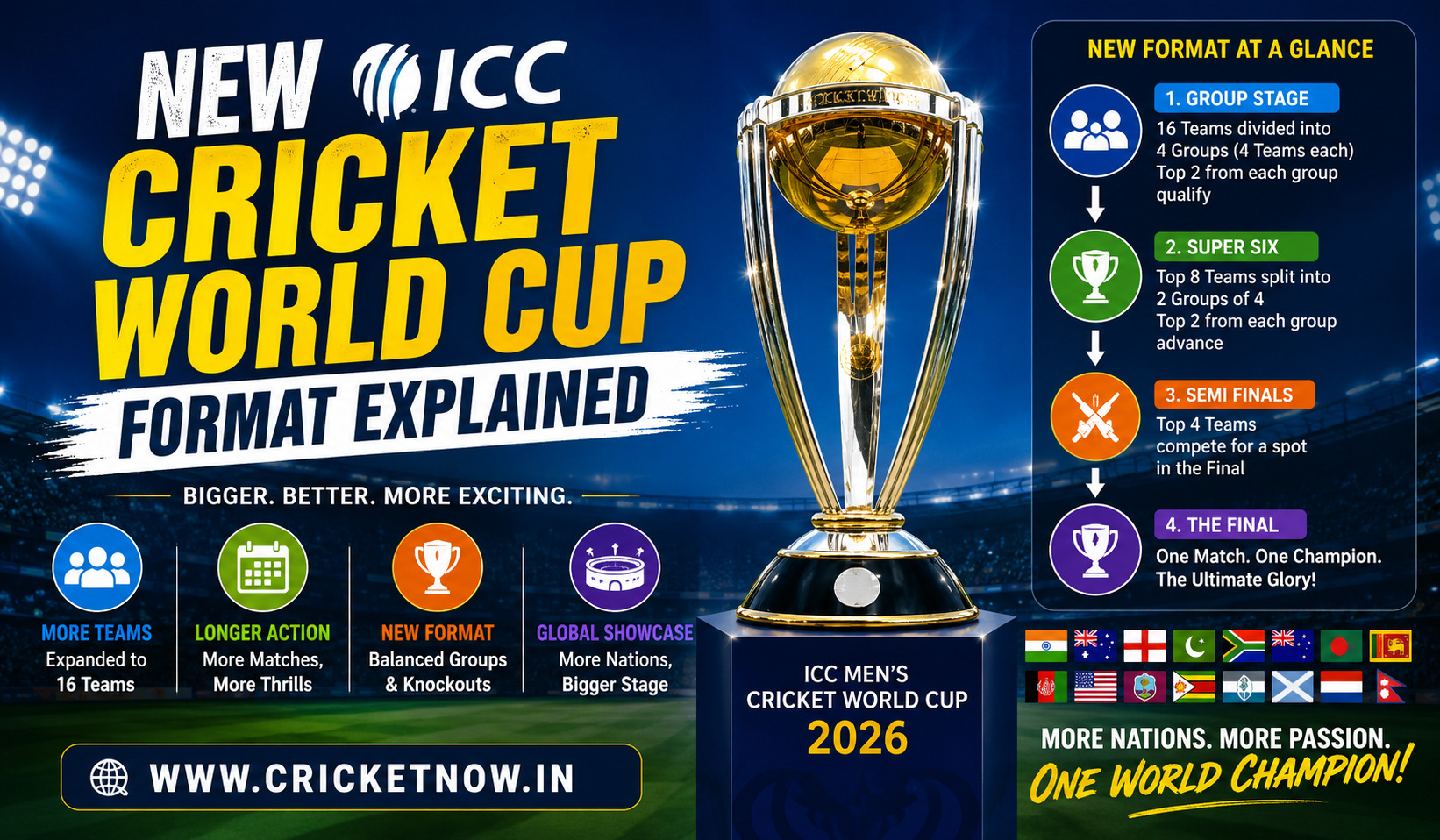
Ten teams and one round-robin table used to be enough to decide the fifty-over world champion. Not anymore. On July 15, 2027, the ICC tore up the old blueprint and confirmed a fourteen-team, three-stage structure for South Africa, Zimbabwe, and Namibia, and it is arguably the biggest shake-up to the tournament since the Super Six era of 1999. If you have spent the last week confused by terms like “Super Series” and “Super 7,” this breakdown of the new ICC Cricket World Cup format will clear it up in one read.
Why the ICC Changed the World Cup Format
Anyone who sat through the 2023 edition in India remembers the problem. By the time the tournament reached its final week, several fixtures had turned into dead rubbers, matches where one side had already been mathematically eliminated and the other had already booked its semi-final spot. A straight round-robin among ten teams sounds fair on paper, but it front-loads the drama and back-loads the filler.
The ICC’s stated goal with the revised ICC Cricket World Cup format is to keep more teams alive, and more matches meaningful, deeper into the event. Think of it the way a football league restructures itself when too many mid-table clashes stop mattering by March. The fix is not to shorten the season, it is to add stakes at every stage.
How the New Three-Stage Format Works
The 2027 Cricket World Cup will field fourteen teams, up from ten, and the path to the trophy now runs through three distinct rounds before the knockouts even begin. Here is the sequence in order:
- Round 1: Super Series (the three lowest-ranked qualifiers)
- Round 2: Group Stage (12 teams, two groups of six, 30 matches)
- Round 3: Super 7 Stage (seven teams, single round-robin, 21 matches)
- Semi-finals and Final (the top four from the Super 7)
Round 1: The Super Series
This is the part that has raised the most eyebrows. Instead of every one of the fourteen qualified sides walking straight into a group stage, the three lowest-ranked teams play a mini round-robin among themselves first. Only the team that finishes on top of that Super Series advances. The other two are done before the main event even starts. It is a brutal filter, but it also gives associate nations and lower-ranked full members a genuine tournament of their own rather than three token appearances against stronger sides.
Round 2: The Group Stage
Once the Super Series winner joins the fold, the field settles at twelve teams split into two groups of six. Each side plays the other five in its group once, producing thirty matches in total. This is closer to what fans are used to from 2019 and 2023, except the pool is smaller and sharper, and every fixture in this pool now feeds directly into the next stage rather than a straightforward top-four cut.
Round 3: The Super 7 Stage
Here is where the format gets genuinely interesting. The top three teams from each of the two groups qualify automatically, and the single best fourth-placed team across both groups grabs the seventh spot. Those seven sides then play a full single round-robin, twenty-one matches in total, and the top four progress to the semi-finals. Notice something important: there are no quarter-finals in this structure. The ICC deliberately cut that stage to avoid a repeat of tournaments where a shock early exit meant a top side never got a second chance to prove itself over a longer stretch of matches. The Super 7 stage essentially replaces what used to be called the Super Six round, just with one extra team and one extra layer of jeopardy.
Knockouts: Semi-Finals and the Final
The top four from the Super 7 stage lock in their seeding based on where they finished in that round-robin, not a fresh reset. The team that finishes first faces the fourth-placed side, while the second and third-placed teams meet in the other semi-final. Win that, and you are in the final. It is a familiar knockout shape, but reaching it now requires surviving far more scrutiny than the old ten-team system ever demanded.
Qualification Path for the 2027 Cricket World Cup
Host nations South Africa and Zimbabwe qualify automatically as ICC Full Members hosting the tournament. Namibia, as an Associate Member co-host, still has to earn its place through the qualifying pathway rather than getting a free pass simply for hosting matches. Beyond the hosts, the top eight ranked ODI sides at the confirmed cut-off date qualify directly, and the remaining four spots are decided through the 2027 Cricket World Cup Qualifier tournament.
This is where ODI World Cup qualification becomes genuinely gripping for the next twelve months. Associate nations chasing that final handful of tickets know exactly what is on the line, and full members sitting on the bubble of that top-eight ranking cutoff cannot afford a sluggish bilateral series between now and the deadline.
How This Compares to the 2019 and 2023 Editions
Both the 2019 World Cup in England and Wales and the 2023 edition in India used the same simple template: ten teams, one round-robin league, everybody plays everybody once, and the top four go straight to the semi-finals. It worked, mostly, but it also meant a side like England in 2019 could lose three of their first four matches and still recover because the format gave enough room to correct course. It also meant that once South Africa was mathematically out in 2023, their remaining fixtures had almost no context left.
The new ICC Cricket World Cup format trades some of that simplicity for structure. There is less room for a slow start once you reach the Super 7 stage, because you are already facing a condensed field of genuine contenders rather than a mixed bag of ten. Compare it to how a golf major cuts the field after two rounds. You are not eliminating weak entrants for the sake of it, you are making sure the back nine on Sunday actually means something for everyone still playing.
What This Means for Fans and Fantasy League Players
For supporters, the practical upside is more matches with something riding on them. A group stage exit under the old system meant your team’s tournament simply ended. Under this structure, even a rocky group stage finish as the fourth seed can still sneak a side into the Super 7 stage if the numbers fall right.
For fantasy league players, this changes squad strategy noticeably. A few things worth tracking as the 2027 Cricket World Cup approaches:
- Players from teams likely to finish fourth in their group carry extra value, since that side gets a genuine second life in the Super 7 stage.
- The extra Super 7 round-robin matches mean top all-rounders accumulate more fantasy points across the tournament than in 2023.
- Associate team players who survive the Super Series become must-watch picks purely for the underdog narrative and the media spotlight that follows them.
- Squad rotation matters more than ever, since the format now demands peak fitness across a longer stretch of consequential fixtures rather than a short burst.
One thing seems certain already: the added Super 7 team increases the odds of an extra India versus Pakistan fixture, a match the ICC itself has called the most commercially valuable in the sport. That alone will shape broadcast schedules and ticket demand well before a ball is bowled.
Frequently Asked Questions
How many teams will play in the 2027 Cricket World Cup?
Fourteen teams will take part, an increase from the ten-team fields used in 2019 and 2023.
What is the Super Series in the new ICC Cricket World Cup format?
It is the opening round, contested by the three lowest-ranked qualified teams. Only the winner advances to the twelve-team group stage.
Are there quarter-finals in the 2027 tournament?
No. The ICC removed the quarter-final stage entirely. Teams move straight from the Super 7 round-robin into the semi-finals.
Where will the 2027 Cricket World Cup be played?
South Africa, Zimbabwe, and Namibia will co-host the tournament, scheduled to run from October to November 2027.