

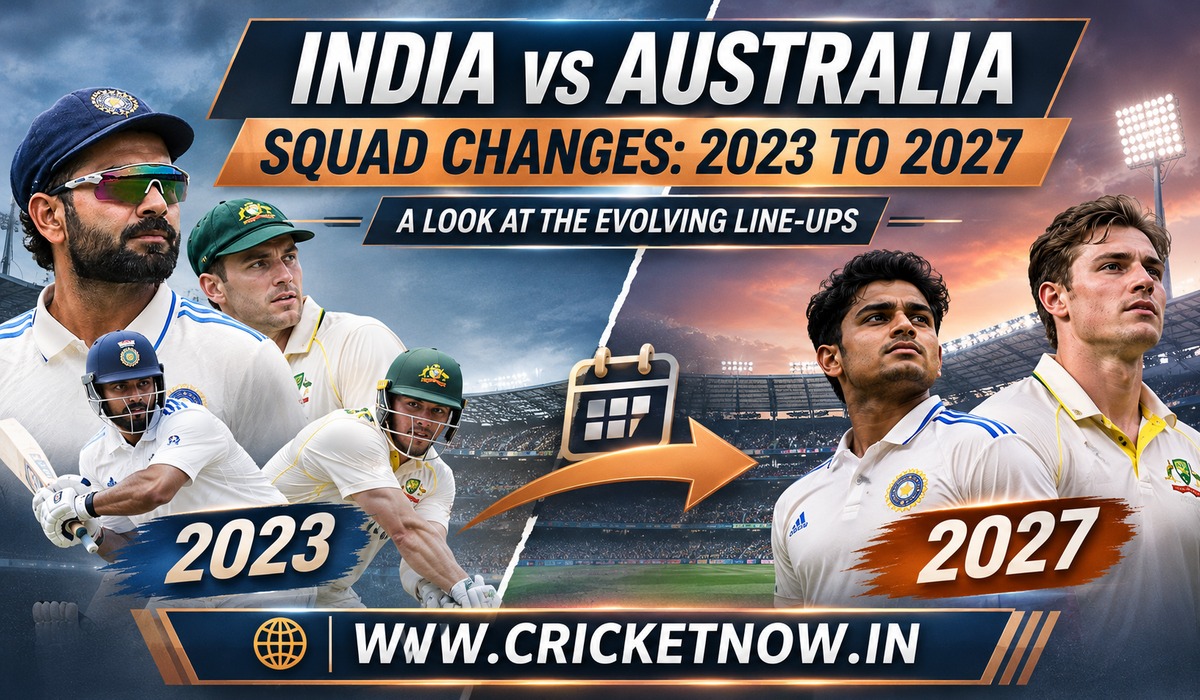
Pat Cummins led Australia into India in 2023, and Rohit Sharma led the hosts. Neither side is built the same way now. Rohit, Kohli and Ashwin have all left Test cricket. The India vs Australia squad changes since then are bigger than most fans realize, and the head-to-head record on Indian soil adds useful context.
Five Tests begin in Nagpur on January 21, 2027. As of November 23, 2026, neither side has named its squad. So the 2027 names below are expected, not official. Here’s how each group has changed, and why it matters.
Australia’s 2023 Squad: A Snapshot
Australia named an 18-player squad for the 2023 tour. It included four spinners at the start: Nathan Lyon, Todd Murphy, Ashton Agar and Mitchell Swepson. Matt Kuhnemann was added later and debuted in Delhi. Meanwhile, Cummins was the captain, with Steve Smith leading in his absence.
Batting was led by Usman Khawaja, who scored 333 runs, including a 180 at Ahmedabad. David Warner also played, though his Test career ended in January 2024. Peter Handscomb played all four Tests. Even so, Australia lost 2-1.
Cameron Green and Travis Head were also in the group. Because the squad leaned on experience, selectors faced criticism after the series. That debate shaped later choices. Now the average age of Australia’s recent squads is a talking point.
What Has Changed for Australia
The biggest loss is Khawaja, who retired after the Sydney Ashes Test in January 2026. Warner is gone too. As a result, the top order has a new look. Jake Weatherald made 201 runs at 22.33 in his Tests so far.
Australia’s July 2026 Bangladesh squad shows the core. It included Cummins, Scott Boland, Alex Carey, Green, Josh Hazlewood, Head, Josh Inglis, Marnus Labuschagne, Lyon, Smith, Mitchell Starc, Weatherald and Beau Webster. The average age was above 33. So selection boss George Bailey said younger players are being prepared.
Meanwhile, Sam Konstas and Nathan McSweeney were named in an Australia A squad for India in September 2026. Handscomb also earned a recall in that group. It was part of a push to build subcontinent experience. That plan reflects lessons from 2023.
India’s 2023 Squad and What Has Changed
India’s squad for the first two Tests in 2023 had 16 names. It included Rohit Sharma (captain), KL Rahul, Gill, Cheteshwar Pujara and Kohli. Spin came from Ashwin, Axar Patel, Kuldeep Yadav and Jadeja. Mohammed Shami, Mohammed Siraj and Umesh Yadav led the pace group.
Since then, change has come quickly. Ashwin retired from international cricket in December 2024. Rohit and Kohli retired from Tests in May 2025. Shubman Gill became Test captain, and he led India in England in 2025.
A recent India Test squad shows the new group. It was led by Gill, with Rahul as vice-captain. It included Yashasvi Jaiswal, Devdutt Padikkal, Rishabh Pant, Dhruv Jurel, Jadeja, Jasprit Bumrah, Sai Sudharsan, Nitish Kumar Reddy, Washington Sundar, Kuldeep and Siraj. Of those, only five also played a role in 2023: Gill, Rahul, Jadeja, Kuldeep and Siraj.
The Spin Department: Then and Now
Spin was the story of 2023, and it remains the biggest change. India lost Ashwin, who took 25 wickets in that series. In his place, Sundar has grown into a key all-rounder. Jadeja, who took 22 wickets, is still there.
Australia’s spin plan is also in flux. Lyon returned from injury for the Bangladesh Tests, and he wants to tour India. Murphy and Kuhnemann are the likely partners. For more, see how India’s spin plans evolved against Australia.
At the same time, Australia’s selectors have said they want a more rounded group than in 2023. That could mean more depth in batting, or a different spin mix. Either way, spin cover is a priority. After all, it decided much of the last series.
The Pace Attack: India
In 2023, India’s pace group was Mohammed Shami, Mohammed Siraj and Umesh Yadav, with Jaydev Unadkat also in the squad. Together they supported a spin-heavy plan. Now the group looks different. Jasprit Bumrah was not in the 2023 squad, but he features in recent Test selections.
Siraj remains the link between the two eras. He is joined by Prasidh Krishna, Akash Deep and Anshul Kamboj in a recent Test squad. That list has more variety than the 2023 group. So India have options for conditions that offer seam movement.
Even so, spin will probably do the heavy lifting at home. The quicks’ job is to take early wickets and set the stage. Because of that, Bumrah’s fitness may be the key selection question. His workload across five Tests will need careful handling.
The Pace Attack: Australia
Australia’s 2023 attack leaned on Cummins and Starc, though Starc missed the first Test in Nagpur. Spin did much of the rest. Now the pace group looks more settled. Cummins, Scott Boland, Josh Hazlewood and Starc were all in the squad for the Bangladesh Tests.
Cummins was named for that series in August 2026, his first Test call since December 2025. Hazlewood also came back from injury. So both are working toward full match fitness. Meanwhile, Green and Webster give Australia pace-bowling all-rounders as extra cover.
That depth is a clear change from 2023. Australia can rotate quicks across five Tests without losing much quality. Of course, the long schedule will test that plan. In India, the quicks’ role is to hold ends and support the spinners.
Wicketkeepers and the Middle Order
Behind the stumps, India have moved on from KS Bharat and Ishan Kishan, who were in the 2023 squad. Rishabh Pant and Dhruv Jurel are the names in recent squads. Pant carries attacking flair, while Jurel offers a steady option. Pant’s fitness remains a question.
Australia are more settled. Alex Carey had a strong Ashes campaign with bat and gloves, and Josh Inglis is also in the squad. Cummins has suggested the team is better balanced with Carey at No. 6. So the keeper’s slot looks secure.
In the middle order, Green is likely at No. 5 after Khawaja’s retirement. Webster could keep his place as well. That mix of batting and bowling gives Australia balance. For India, Gill, Rahul and the keeper form the core.
Captains and Leadership Groups
Leadership has changed on both sides. In 2023, Rohit Sharma captained India, with KL Rahul as vice-captain. Now Shubman Gill leads the Test side, and Rahul remains his deputy in the recent squad. That continuity at vice-captain is useful.
Australia kept Cummins as captain. Smith has been his preferred stand-in, and he led the side in the Sydney Ashes Test. Head was appointed co vice-captain in 2023, so the leadership group has been stable for several years. Even so, the Khawaja era has ended.
Still, captaincy will be tested differently in 2027. Gill has led India in England but not against Australia in a Test series. Cummins led Australia in the first two Tests of the 2023 series, and both were lost. So both leaders have something to prove.
Why Selection Looks Different This Time
Selectors on both sides are thinking differently. Australia’s Bangladesh squad had an average age above 33. Selection boss George Bailey admitted there are parallel moves to prepare a younger group for India. As part of that, Australia A played two four-day matches in Lucknow in September 2026.
India, meanwhile, have already turned over much of their Test group. The 2023 squad for the first two Tests had 16 names, many of them long-serving. Now the list has several newer faces. So the squad change story is as much about age as about names.
Both approaches carry risk. Youth brings energy but less experience on turning pitches. Veterans bring knowledge but may lack fitness. Because five Tests are scheduled, depth will matter on both sides.
Expected Squads for the 2027 Series
These lists use recent Test squads and are not confirmed. They are accurate as of November 23, 2026.
Expected India players:
- Shubman Gill (captain), KL Rahul, Yashasvi Jaiswal
- Rishabh Pant (fitness permitting), Dhruv Jurel
- Ravindra Jadeja, Washington Sundar, Kuldeep Yadav
- Jasprit Bumrah, Mohammed Siraj
Expected Australia players:
- Pat Cummins (captain), Steve Smith, Travis Head
- Marnus Labuschagne, Cameron Green, Alex Carey
- Nathan Lyon, Todd Murphy, Mitchell Starc, Josh Hazlewood
Which means both sides will enter with a mix of veterans and newer faces. Of course, injuries and form could change this before January. For a preview of the contests, read the five key player battles for this series.
Key Takeaways
- Australia’s loss: Khawaja and Warner have both left the Test team since 2023.
- India’s captaincy: Gill has replaced Rohit as Test captain.
- Retirements: Ashwin, Rohit and Kohli are no longer in India’s Test plans.
- Spin plans: Lyon, Murphy and Kuhnemann face Jadeja, Sundar and Kuldeep.
- Squads: Neither side has announced a squad for the 2027 series.
FAQs
Who captained Australia in India in 2023?
Pat Cummins was the captain, though Smith led the side in some Tests.
Who captains India now in Tests?
Shubman Gill is India’s Test captain.
Has Khawaja retired from Test cricket?
Yes, Khawaja retired after the Sydney Ashes Test in January 2026.
Is the 2027 squad official?
No, neither team has named its squad as of November 23, 2026.
Which Indian spinners remain from 2023?
Jadeja and Kuldeep Yadav are the main spinners still in the Test setup.
Conclusion
The India vs Australia squad changes between 2023 and 2027 are large on both sides. India have a new captain and a new spin base, while Australia have a new top order. Because squads are not final, the story is still developing. What is clear is that the 2027 contest will look very different from the last.