

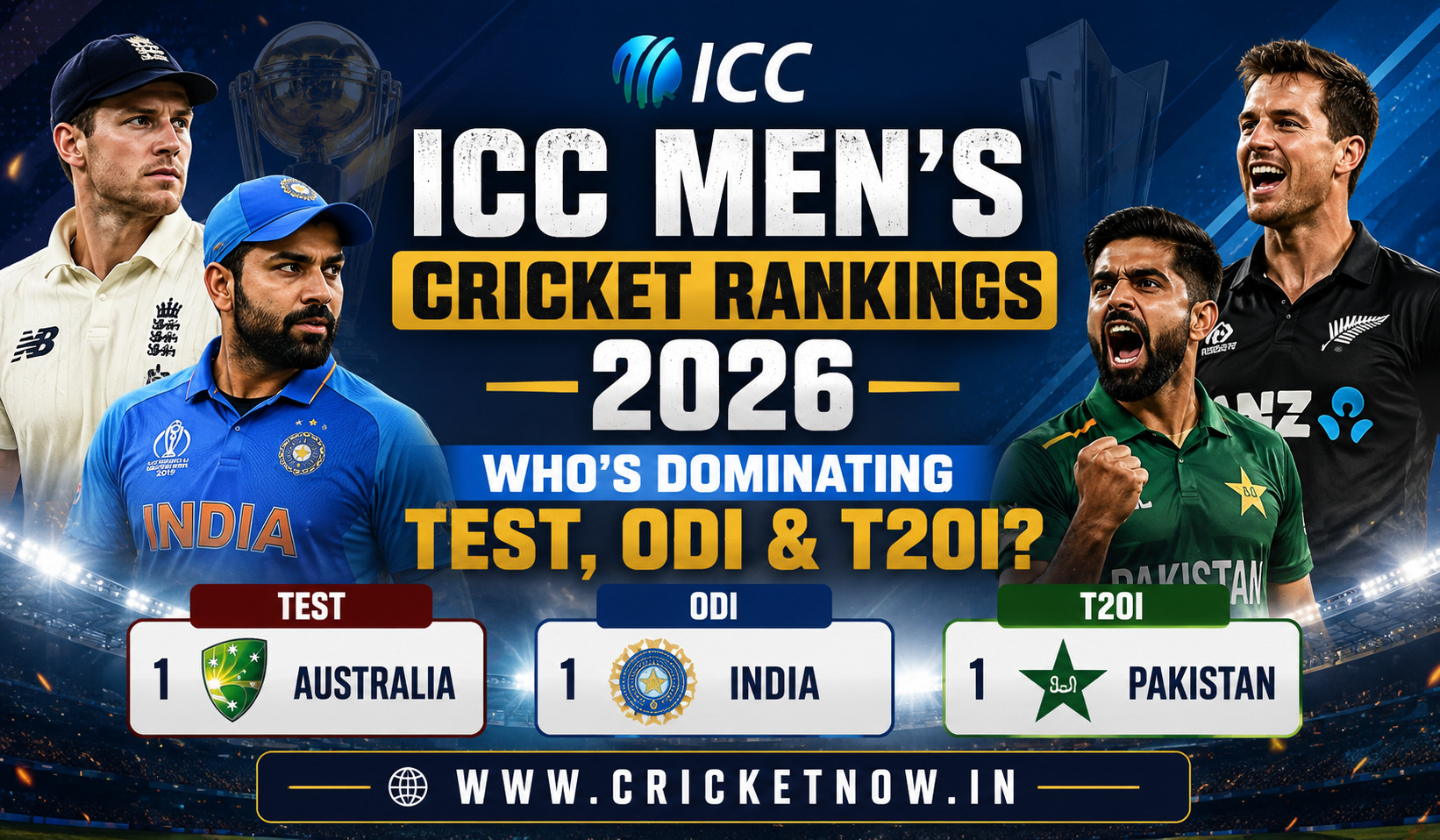
Australia sit on a Test rating of 131, a number no side has touched since the rankings system was overhauled years ago. That single figure tells you almost everything about where power currently sits in world cricket, but only if you know how to read it. The ICC Men’s Cricket Rankings are updated constantly, and right now they are telling three very different stories across the three formats.
Where the ICC Men’s Cricket Rankings Stand Right Now
Anyone who follows the ICC Men’s Cricket Rankings closely knows they never sit still for long. A single series can shift the entire table, and July 2026 has already produced some separation at the top of each format. Here is the snapshot as things stand.
Test rankings: Australia out on their own
Australia lead the Test table with a rating of 131 from 24 matches, a gap of 12 full points over second-placed South Africa, who sit on 119. New Zealand hold third on 106, with India fourth on 104 and England fifth on 99. That gap between first and second is not small in Test cricket terms. It usually takes a lost series or two to close a margin that size, so unless South Africa put together something special, Australia look set to hold this position for a while.
ODI rankings: India refuse to budge
In the 50-over format, India remain the team everyone else is chasing. They lead the ODI rankings with a rating of 121 from 30 matches, comfortably ahead of New Zealand on 110 and Australia on 102. This is not a new development. India have occupied the top ODI spot for an extended stretch now, built on a batting order that rarely has a genuinely weak link and a bowling attack that adapts well across conditions.
T20I rankings: a genuine three-way fight
The T20I picture is the tightest of the lot. England currently top the T20I rankings on 268, with India just behind on 260 and Australia level with them, also on 260. New Zealand and South Africa round out the top five. Given how little separates the top three, a single bilateral series or ICC event could reshuffle this list within weeks, which is exactly what makes the shortest format so entertaining to track.
Australia’s Test Rankings Lead Did Not Happen by Accident
A 12-point cushion at the top of the Test rankings is not built on one good tour. Australia’s rise reflects consistent results across home and away conditions, something the ratings formula rewards heavily since it weighs opposition strength rather than just win-loss records. Beating a side ranked below you barely moves the needle. Beating South Africa or India away from home moves it significantly.
Compare this to where things stood only a couple of years back, when India and Australia were separated by single-digit points after the World Test Championship decider at The Oval. That margin has now stretched out considerably, and it says something about how Australia have managed transitions in personnel without a dip in results, while other top-five sides have had more inconsistent runs.
India’s White-Ball Grip Across the ODI and T20I Rankings
India’s position across the shorter formats deserves its own conversation. Topping the ODI rankings is one thing, but India also went unbeaten on the way to winning the 2026 T20 World Cup on home soil, defeating New Zealand by 96 runs in the final at the Narendra Modi Stadium. That victory made them the first team to win two consecutive T20 World Cup titles and the first to lift the trophy on home turf.
Jasprit Bumrah was named Player of the Match in that final and finished the tournament with 14 wickets, sharing the top wicket-taker honours with Varun Chakravarthy. Sahibzada Farhan of Pakistan was the tournament’s leading run-scorer with 383 runs, a reminder that team rankings do not always tell the full story of who is playing the best cricket at a given moment.
Even with that trophy in the cabinet, India sit second in the T20I rankings behind England. That is the quirk of a ratings system built on a rolling multi-year window rather than a single tournament result, and it is a detail casual followers of the ICC Men’s Cricket Rankings often miss.
The Individual Rankings Tell Their Own Story
Team standings only capture half the picture. The player rankings inside the wider ICC Men’s Cricket Rankings system reveal who is actually doing the damage. A few names stand out this month:
- Travis Head (Australia) – top of the Test batting rankings with a rating of 853, the standout reason Australia’s top order has been so hard to bowl at.
- Harry Brook (England) – leads the Test batting charts on the wider table with a rating close to 857, form that has kept England competitive despite the gap to Australia in the team standings.
- Rohit Sharma (India) – sits at the top of the ODI batting rankings with a rating of 781, still setting the tone at the top of India’s order.
- Abhishek Sharma (India) – leads the T20I batting rankings with a rating above 900, a huge factor behind India’s power-hitting reputation in the format.
Notice how many Indian and Australian names dominate this list. That is not a coincidence. Team success in the ICC Men’s Cricket Rankings almost always tracks back to two or three individuals performing at a level well above the rest of the field.
How the Ratings Formula Actually Works
The maths behind the ICC Men’s Cricket Rankings confuses a lot of fans, so here is the simplest way to think about it. Picture a credit score for a cricket team. Beating a stronger opponent boosts your score more than beating a weaker one. Losing to a weaker opponent hurts your score more than losing to a stronger one. Draws are treated on a sliding scale depending on who was rated higher going in.
Every team’s points total gets divided by the number of matches and series played over roughly the last three to four years, which produces the “rating” you see in the tables. This rolling window is exactly why a single World Cup win, however impressive, does not automatically hand a team the number one spot. It also explains why Afghanistan and Ireland currently sit outside the official Test rankings table entirely, since neither side has yet played the minimum eight Tests required for a rating to be calculated.
What Could Move the Rankings Next
A few storylines are worth watching over the coming months. South Africa need a strong away series to genuinely threaten Australia’s Test rankings lead, since home form alone will not close a 12-point gap fast enough. In the T20I rankings, with England, India, and Australia separated by single-digit points, any bilateral series between the three could flip the top spot more than once before year’s end. And in ODIs, New Zealand’s climb to second place suggests they are quietly building toward the next 50-over World Cup cycle, even if India’s lead still looks comfortable for now.
Frequently Asked Questions
How often are the ICC Men’s Cricket Rankings updated?
Ratings are recalculated after the completion of every international match or series, so the tables can shift multiple times within a single month depending on the international calendar.
Why does a World Cup winner not always top the rankings?
Because the rating is calculated from a rolling three-to-four-year body of results, not a single tournament. A trophy win boosts a team’s points, but it has to be weighed against everything else in that window, which is why India could win the 2026 T20 World Cup and still sit second in the T20I rankings.
What is considered an average rating in the ICC Men’s Cricket Rankings?
A team that wins about as often as it loses against a mixed schedule of stronger and weaker opponents should sit around a rating of 100. Anything meaningfully above that reflects sustained, above-average results.
Why are Afghanistan and Ireland missing from the Test rankings?
Both nations have not yet played the minimum of eight Test matches required for the ICC to generate an official rating, even though they compete regularly in ODIs and T20Is