

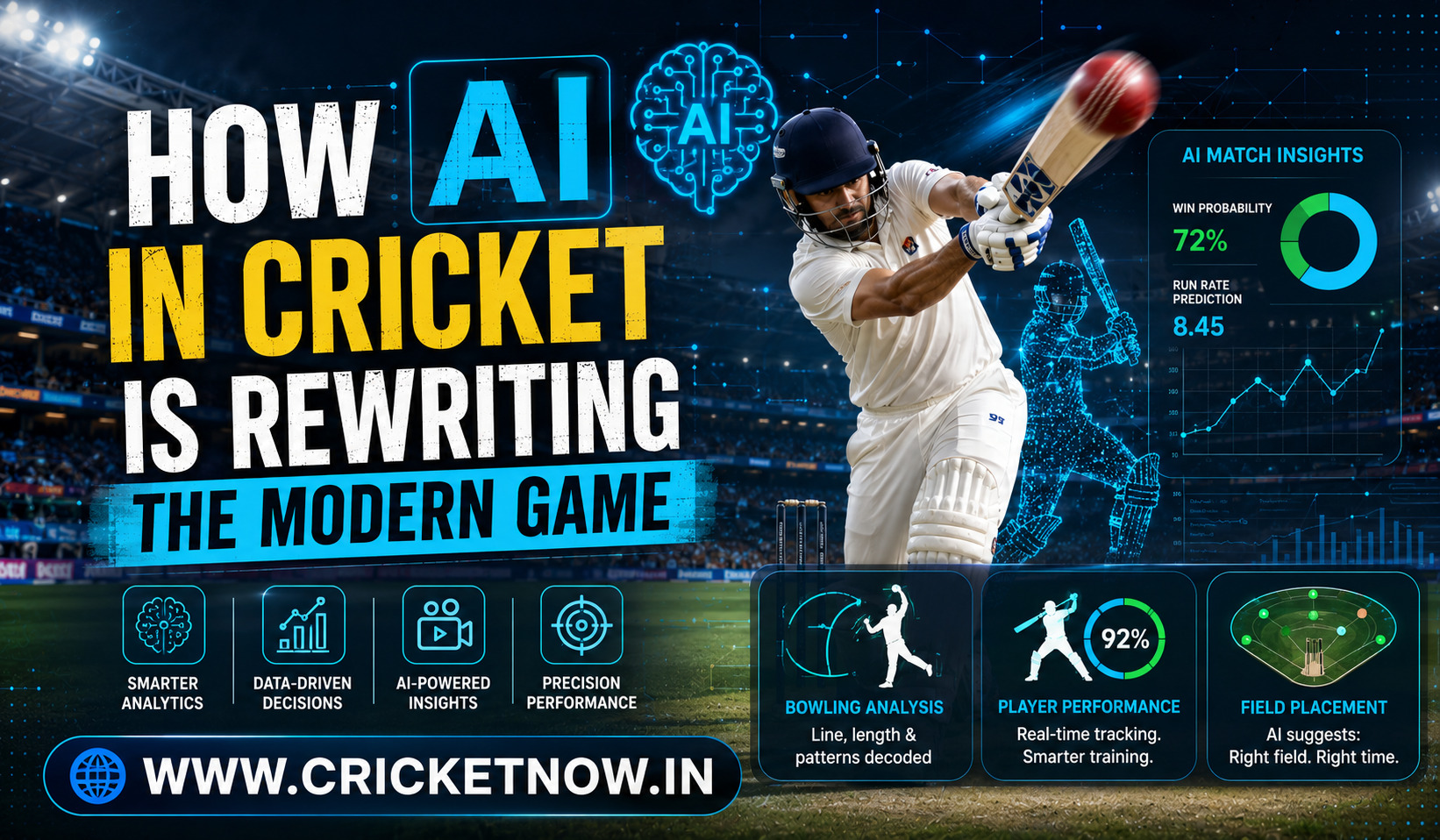
A batter walks off after a marginal caught-behind decision, and instead of an argument, there is a review, a ball-tracking replay, and an answer inside ninety seconds. That single sequence sums up where the sport stands right now. AI in cricket has moved from a broadcast gimmick to the backbone of how the game is umpired, coached, scouted, and even watched from your couch.
This is not a story about robots replacing bowlers. It is a story about how data, sensors, and machine learning are quietly reshaping decisions that used to rest entirely on human judgment, for better and occasionally for worse.
What Does AI in Cricket Actually Mean?
When people say AI in cricket, they usually lump together a few different things: ball-tracking systems, predictive analytics, wearable sensors, and automated video analysis. None of these are science fiction. They are tools that have been quietly integrated into professional cricket over the last decade and a half.
The shift really began with the Decision Review System in 2008, but what has changed since then is the depth of the data underneath it. Early DRS technology just told you where the ball was going. Modern systems combine that with player biomechanics, historical dismissal patterns, and pitch behavior models trained on thousands of deliveries.
From Gut Feel to Data Feed
Coaches used to rely on scorebooks and memory. Now a head coach can pull up a bowler’s release point variance from the last six months on a tablet during a drinks break. That is the practical, unglamorous side of AI in cricket, and it is where most of the real value sits.
DRS Technology and the End of Umpiring Guesswork
Nothing illustrates cricket technology’s impact better than the review system. Hawk-Eye ball-tracking, first trialed in international cricket around the 2008 series between India and Sri Lanka before wider ICC adoption, claims prediction accuracy within a few millimeters on trajectory. UltraEdge and Snickometer analyze sound spikes against bat-ball contact to settle edges that used to be pure guesswork.
Here is what changed on the field because of it:
- Fewer marginal howlers: Bat-pad decisions and tight LBW calls are now checked rather than argued.
- Strategic reviews: Captains now manage two unsuccessful reviews per innings like a resource, not an afterthought.
- Slower over rates in some formats: The trade-off nobody talks about enough is that accuracy has added time to the game.
Critics still argue that ball-tracking projects a probable path rather than a certainty, especially on marginal LBW shouts where the ball is predicted to clip the stumps. That debate is not going away, but the technology has undeniably reduced the number of decisions that used to swing entire Test matches on human error alone.
Player Analytics Are Rewriting Selection and Strategy
Selection panels used to lean heavily on recent form and reputation. Player analytics has changed that conversation entirely. Franchises in the IPL and Big Bash now build statistical models around a batter’s strike rate against left-arm spin in the middle overs, or a bowler’s economy rate specifically at the death against right-handers.
Wearables and Workload Management
GPS vests and heart-rate monitors, the kind used by teams like Cricket Australia and several IPL franchises, track distance covered, sprint speed, and bowling load across a training week. This is not optional anymore for fast bowlers. Workload management built on this kind of data is a big reason boards now rotate quicks like James Anderson-era England once resisted doing, protecting careers that used to be cut short by stress fractures nobody saw coming until it was too late.
Opposition Scouting Gets Surgical
Before a series, analysts now build heat maps of where a rival batter scores most of their runs, which deliveries draw false shots, and how their footwork changes under pressure in a run chase versus batting first. This used to take a scout weeks of tape. Now it takes an afternoon and a properly trained model.
A simple analogy: it is the difference between a chess player memorizing an opponent’s last ten games versus having a computer flag every single pattern in their opening moves. The prep work gets faster, but the player still has to execute under lights, in front of sixty thousand people, with the scoreboard pressure that no dataset can replicate.
Fantasy Cricket and Fan Engagement Get an AI Upgrade
For fans, especially fantasy league players, cricket technology has changed how squads get picked. Platforms now use predictive models pulling in pitch reports, head-to-head records, and recent player analytics to suggest captaincy picks before a match starts.
This has made fantasy cricket more competitive and, honestly, a bit more addictive. Where fans once picked a captain based on gut feel or a favorite player, many now check win probability charts and expected fantasy points before locking a team. It has raised the floor for casual players while narrowing the edge that used to belong to obsessive stat-trackers alone.
Broadcast Innovation: Watching Cricket Through a Smarter Lens
Broadcasters have leaned hard into AI in cricket to keep viewers engaged. Win probability graphics that update ball by ball, similar to what ESPNcricinfo popularized, now sit permanently on screen during run chases. Ball-by-ball predictive models estimate a team’s chances based on required run rate, wickets in hand, and historical chase data from similar situations.
Automated highlight generation is another quiet shift. Instead of an editor manually clipping every boundary, machine learning models now flag key moments (wickets, sixes, close DRS calls) almost instantly, which is part of why highlight packages hit social media within minutes of a session ending rather than hours.
The Human Element: What AI Cannot Replace
None of this replaces the parts of cricket that actually make people watch. No model predicted Ben Stokes at Headingley in 2019. No algorithm can bowl a yorker under pressure in the final over of a T20 chase with the finish line right there. Cricket technology can tell a captain the statistical odds of a field placement working, but it cannot make the fielder take the catch.
There is also a growing concern among purists that leaning too hard on data risks flattening instinct out of the game entirely. A captain who trusts a gut call over a model, and gets it right, is still one of the most satisfying moments in the sport. AI in cricket works best as a second opinion, not the final word.
Where Cricket Technology Goes Next
The next phase looks less like new gadgets and more like better integration of what already exists. A few directions worth watching:
- Real-time biomechanical alerts during play to flag bowler injury risk before it happens, not after.
- AI-assisted coaching feedback delivered to players through wearables between overs rather than after a session ends.
- More transparent ball-tracking data shared publicly to quiet the recurring “how accurate is this really” debate among fans and pundits.
Boards that get ahead of this will have a real edge in both performance and fan trust. The ones that treat it as a marketing add-on rather than a core system will fall behind quickly.
FAQ: AI in Cricket
How accurate is ball-tracking technology in cricket?
Ball-tracking systems like Hawk-Eye are generally reported to be accurate within a few millimeters for tracked trajectory, though the prediction beyond the point of impact (used for LBW calls) still carries some margin of error, which is why the “umpire’s call” buffer exists in DRS technology.
Does AI in cricket replace umpires?
No. On-field umpires still make the initial call. Technology only gets involved when a review is requested, and even then, decisions like caught-behind or LBW still require a mix of automated data and human interpretation by the third umpire.
How do IPL teams use player analytics during auctions?
Franchises build statistical profiles covering a player’s performance in specific match phases, against specific bowling or batting types, and under specific pressure situations, then weigh that against auction price to avoid overpaying for reputation over current form.
Is fantasy cricket becoming too reliant on data tools?
It is trending that way for competitive players, though casual fans still largely pick based on favorite players and gut instinct. The gap between data-driven and instinct-driven fantasy teams is widening each season.