

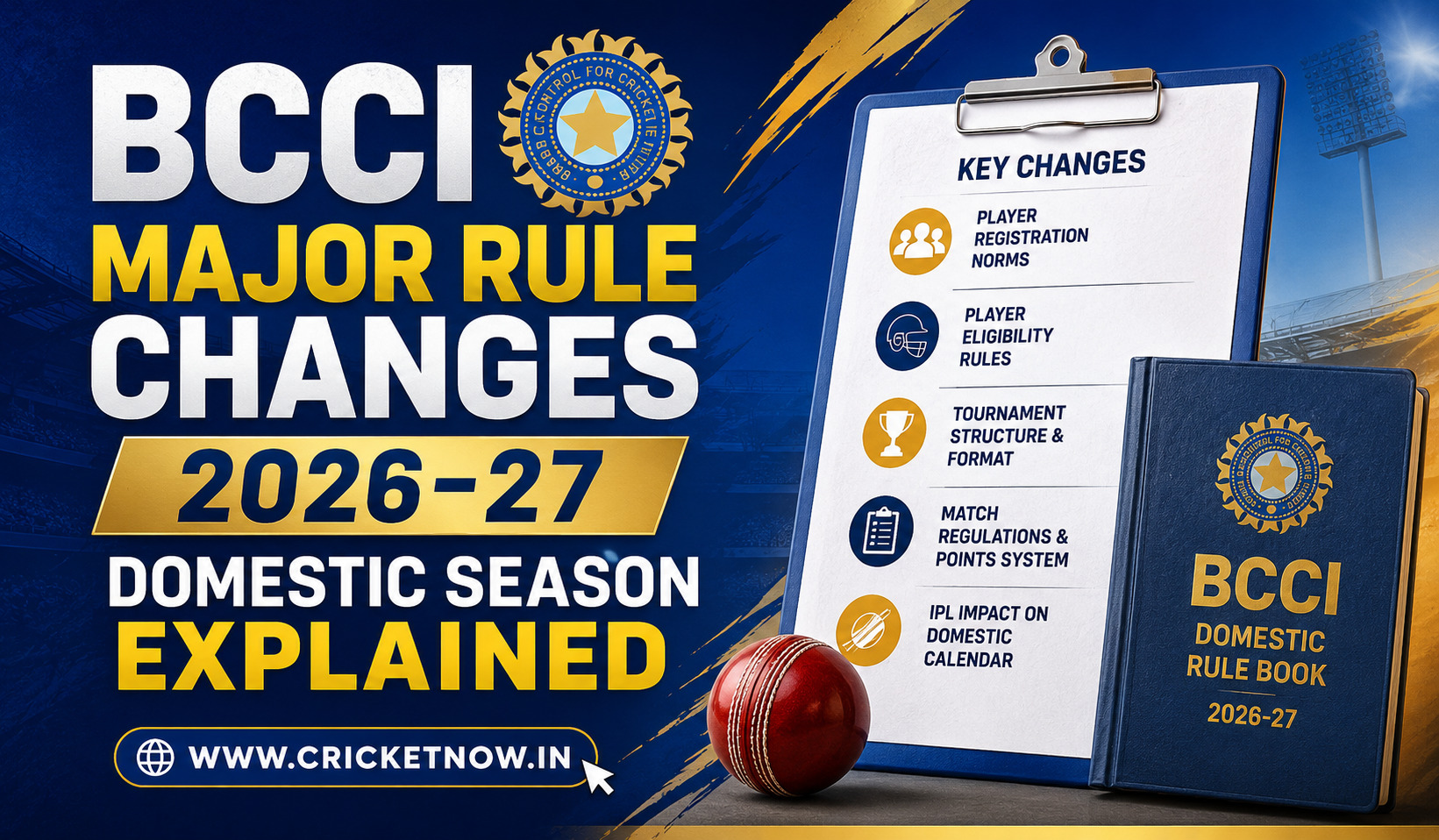
The governing body of Indian cricket has officially drawn a hard line in the sand ahead of the upcoming August kickoff. When the prestigious Duleep Trophy commences on August 23, players and coaching staff will operate under a heavily revised code of conduct that fundamentally alters multi-day match strategies. Analyzing the BCCI major rule changes 2026-27 domestic season reveals a clear mandate to eliminate tactical loopholes, enforce strict player discipline, and protect the overall integrity of the sport at the grassroots level.
The Scope of the BCCI Major Rule Changes 2026-27 Domestic Season
The board circulated these massive updates to state cricket associations in late July, ensuring all match officials undergo thorough awareness programs before the first ball is bowled. These new BCCI domestic cricket rules align closely with the latest Marylebone Cricket Club updates, but they add specific local flavor to combat unique challenges seen in regional tournaments. The comprehensive BCCI major rule changes 2026-27 domestic season package comes into full effect on August 1, two whole months before the global laws update takes effect.
Every single squad must adapt rapidly, as the window for pre-season preparation is remarkably small. With over one thousand professional matches scheduled across various age groups and formats, these strict adjustments will dictate the tactical flow of the entire calendar year. Understanding the BCCI major rule changes 2026-27 domestic season is vital for any serious fan who wants to follow the upcoming winter schedule intelligently.
Why the Governing Body Intervened
For years, astute captains found subtle gray areas within the existing playing conditions, exploiting them to gain unfair advantages during crucial knockout games. The BCCI major rule changes 2026-27 domestic season specifically target these exact behavioral patterns. By removing ambiguity in the rulebook, the governing body ensures that match results rely purely on athletic skill rather than clever manipulation of the playing conditions.
Match-Long Suspensions for Deliberate No-Balls
Perhaps the most aggressive stance taken within the BCCI major rule changes 2026-27 domestic season involves player discipline and batter safety. Under the revised Playing Condition 41.8, any bowler found guilty of intentionally delivering a front-foot no-ball will face an immediate suspension from bowling for the remainder of the entire match. Previously, this specific penalty only extended to the end of that current innings.
This exact same match-long ban applies to bowlers who deliberately hurl dangerous full tosses above the waist of the batter, commonly known as beamers. The on-field umpires carry the immense responsibility of determining whether the act was an intentional aggressive act or simply a genuine loss of grip on the leather.
Protecting Batter Safety at the Crease
Allowing a bowler to stay in the match after a deliberate beamer is exactly like letting a football player stay on the pitch after an intentional, malicious foul. It actively rewards dangerous behavior. The central aim of these BCCI domestic cricket rules is to eradicate physical intimidation tactics completely. Fast bowlers must rely on skill, searing pace, and late swing, rather than threatening the physical safety of their opponents to break their batting concentration.
Mandating the Completion of the Final Over
The second massive shift within the BCCI major rule changes 2026-27 domestic season focuses on the closing moments of a long day of first-class cricket. Under the newly amended Rule 12.5.2, the final scheduled over of the day must be completed in its entirety, regardless of whether a wicket falls during that specific over.
In the past, if a batter was dismissed during the final scheduled over, umpires often called stumps immediately to end the day. Batting captains loved this old rule because it saved them from exposing a new batter to the most difficult lighting conditions of the fading afternoon. The fielding side, despite taking a brilliant late wicket, lost the opportunity to bowl at a fresh batter.
Closing the Tactical Nightwatchman Loophole
This specific adjustment forces teams to take genuine strategic risks. If your top-order batter gets dismissed with three balls remaining in the day, the incoming player must walk out and survive those high-pressure deliveries. The updated Ranji Trophy rule changes ensure that fielding teams receive the full tactical reward for taking a late wicket, while batting teams can no longer hide behind the early drawing of stumps.
Banning Final-Innings Declarations and Forfeitures
Maintaining the purity of the competition is a heavy theme throughout the BCCI major rule changes 2026-27 domestic season. To address historic controversies, Rule 15.2 now strictly prohibits teams from declaring or forfeiting the final innings of a multi-day match.
In previous decades, competing captains occasionally struck informal agreements on the final day of a dead-rubber match. If one team desperately needed an outright win to qualify for the playoffs, the opposition might forfeit an innings to artificially create a quick run chase. The implementation of the BCCI major rule changes 2026-27 domestic season abolishes this practice entirely.
Securing the Indian Domestic Season 2026-27
The governing body rightly viewed these contrived results as deeply damaging to the spirit of the game. By implementing these specific Ranji Trophy rule changes, organizers guarantee that every single match plays out organically over four full days. Teams must earn every single point through genuine athletic effort rather than mathematical manipulation. This ensures the Indian domestic season 2026-27 remains a true test of merit from the first week until the finals.
Head Coaches Permitted During Drinks Breaks
While the red-ball format sees strict tightening, the BCCI major rule changes 2026-27 domestic season actually relax certain rigid restrictions for limited-overs cricket. For the first time, head coaches are officially permitted to enter the field of play during designated drinks intervals in domestic one-day matches.
This brilliant update mirrors recent proposals at the international level and acknowledges the deeply strategic nature of modern white-ball cricket. Coaches can now deliver immediate feedback, assist with adjusting complex fielding plans, and physically calm their players during high-pressure run chases without relying on chaotic, misunderstood hand signals from the distant boundary rope.
Elevating Tactical Gameplay
Allowing direct communication transforms the middle overs of a fast-paced one-day game. Captains do not have to carry the entire tactical burden completely alone. When you study the BCCI major rule changes 2026-27 domestic season, it becomes obvious that the board wants to see higher quality strategic battles, preparing local players thoroughly for the intense mental demands of international franchise leagues.
Easing Restrictions on Wicketkeepers
The final major component of the BCCI major rule changes 2026-27 domestic season provides much-needed practical relief for wicketkeepers. Rule 27.3 has been modified to state that a wicketkeeper must only have their gloves completely behind the stumps at the exact moment the ball is delivered by the bowler.
Under the old legislation, keepers had to remain completely static and positioned strictly behind the stumps from the exact moment the bowler began their run-up. This outdated rule often led to umpires calling unfair no-balls or nullifying completely legitimate stumpings simply because a keeper shifted their weight slightly early to anticipate a turning delivery.
Additional Enhancements for the Indian Domestic Season 2026-27
Beyond the five primary pillars, the BCCI major rule changes 2026-27 domestic season include several vital adjustments that will heavily impact the Indian domestic season 2026-27. Here is a clear breakdown of those highly important supplementary rules:
- Overthrow Clarifications: An overthrow is now strictly defined as an active throw made in a genuine attempt to break the stumps, effect a run-out, or prevent runs. Casual misfields that merely trickle away between fielders are no longer penalized as aggressive overthrows.
- Extra Crease Markings: White-ball matches will feature additional white painted guidelines on both sides of the pitch. This helps umpires judge wide deliveries with far greater visual consistency.
- Boundary Catches: Fielders stepping entirely outside the boundary rope can only touch the falling ball once while airborne, requiring them to ground themselves safely inside the field of play for the remainder of the catch.
FAQ: BCCI Major Rule Changes 2026-27 Domestic Season
When do the new regulations officially come into effect?
The revised playing conditions for the Indian domestic season 2026-27 officially activate on August 1. They will be heavily utilized right away during the Duleep Trophy tournament starting on August 23.
Which specific rule impacts the Ranji Trophy the most?
The most impactful of the Ranji Trophy rule changes is undoubtedly the strict ban on declaring or forfeiting the final innings. This prevents teams from manufacturing artificial run chases on the final day, forcing them to play proper, grinding first-class cricket to secure their outright victories.
How does the new suspension rule work for fast bowlers?
Under the updated BCCI domestic cricket rules, if an on-field umpire decides a bowler deliberately bowled a front-foot no-ball or a dangerous waist-high full toss, that bowler is banned from bowling for the remainder of the entire match, rather than just that specific innings.
Can head coaches enter the field during multi-day games?
No, the rule relaxing restrictions on head coaches only applies specifically to domestic one-day matches. Multi-day red-ball cricket will maintain the traditional boundaries regarding coaching staff entering the active field of play.