

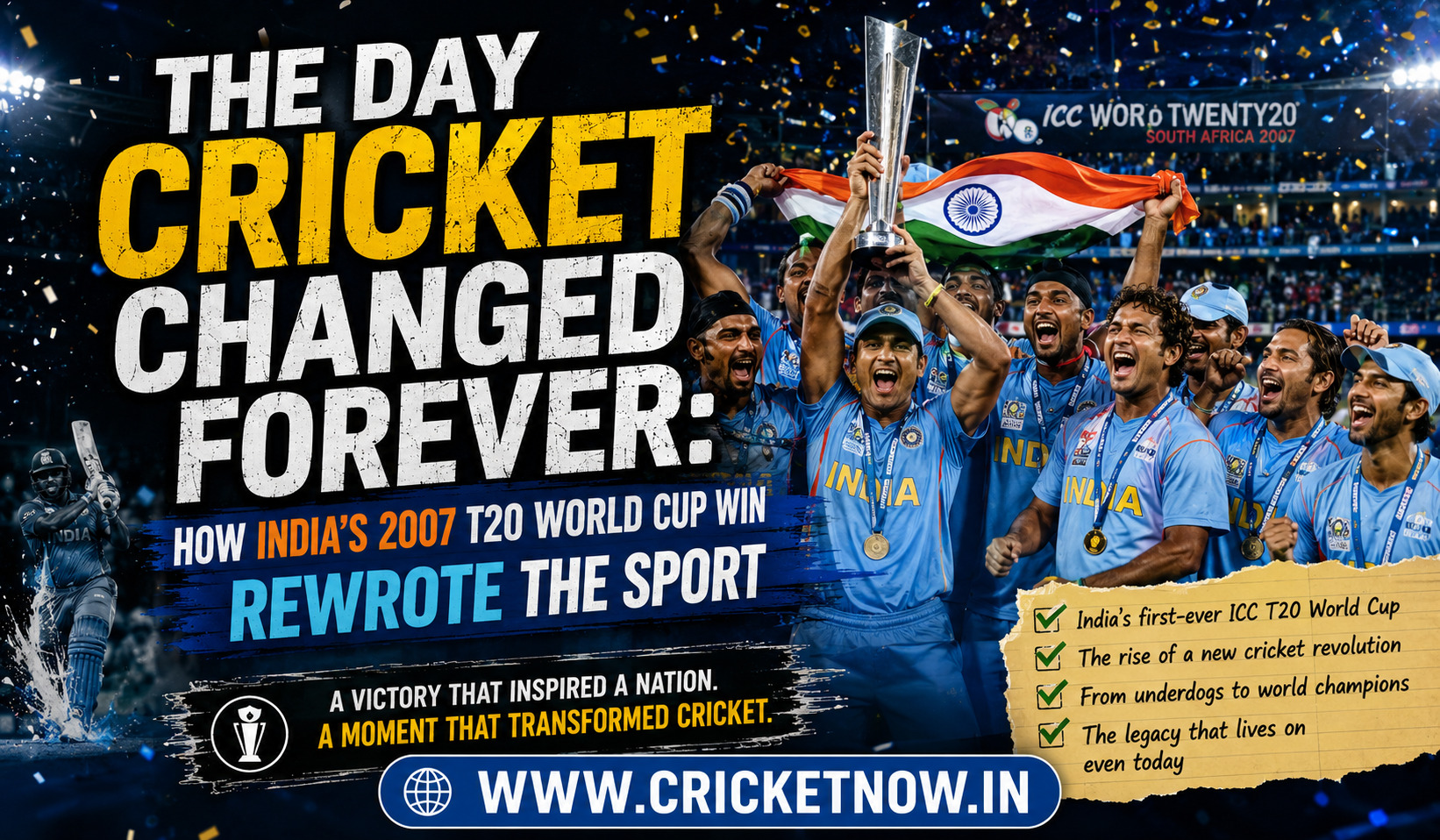
On September 24, 2007, S Sreesanth caught Misbah-ul-Haq at short fine leg, and Indian cricket changed forever. Before that afternoon in Johannesburg, short-format cricket was treated like a side show by the Board of Control for Cricket in India. Winning the 2007 T20 World Cup did not just add a trophy to the cabinet; it completely remade the global cricket economy and shifted the center of power to the Indian subcontinent.
The Skepticism Surrounding the 2007 T20 World Cup
Heading into the tournament in South Africa, the Indian cricket ecosystem showed almost zero interest in Twenty20 cricket. The national team had only played a single T20 international before the event, defeating South Africa in 2006. Senior icons like Sachin Tendulkar, Sourav Ganguly, and Rahul Dravid opted out of the tournament entirely.
Public sentiment toward the sport was at an all-time low. India had suffered a humiliating first-round exit at the 50-over World Cup in the Caribbean just six months prior. Sending a young squad under a newly appointed, long-haired captain named Mahendra Singh Dhoni seemed like a low-risk experiment for a format nobody took seriously.
The administration saw the event as a brief disruption to the traditional international calendar. Yet, that absence of high expectations gave the young squad complete freedom to play without fear.
Mahendra Singh Dhoni and a Fearless Young Squad
The decision to send a youthful roster proved to be a masterstroke. Free from the baggage of past failures, young players brought an aggressive energy that suited the shortest format.
Unconventional Leadership on the Big Stage
Dhoni brought a calm, tactical mind to the dugout. He did not rely on traditional theories or established reputations. He trusted his instincts and backed unheralded players in pressure situations.
Key Match Winners Who Stepped Up
- Gautam Gambhir: The top-order anchor who scored 227 runs in the tournament, including a vital 75 in the final.
- Yuvraj Singh: The explosive middle-order hitter who smashed six sixes in an over off Stuart Broad against England.
- RP Singh: The left-arm pacer who finished as India’s leading wicket-taker with 12 scalps at an economy rate of 6.33.
- Irfan Pathan: The versatile all-rounder who took 3 for 16 in the final to earn the Player of the Match award.
Iconic Moments That Defined the Tournament
India’s march to the trophy was filled with high-drama moments that captured the imagination of millions back home.
The Historic Bowl-Out Against Pakistan
In their group stage match against Pakistan, the game ended in a thrilling tie. Instead of a Super Over, the rules at the time dictated a football-style bowl-out to decide the winner.
While Pakistan used specialist fast bowlers who missed the stumps entirely, Dhoni selected players like Virender Sehwag and Robin Uthappa who hit the target with ease. India won 3-0, showcasing tactical preparation that set them apart from the competition.
Yuvraj Singh Hits Six Sixes in Kingsmead
During a crucial Super 8 fixture against England, Yuvraj Singh carved his name into the history books. Sparked by a heated verbal exchange on the field, Yuvraj hit Stuart Broad for six consecutive sixes in a single over.
He reached his half-century in just 12 balls, setting a record for the fastest fifty in international cricket across all formats. It was a jaw-dropping display of power hitting that proved Twenty20 cricket was the future of sports entertainment.
The High-Stakes Final in Johannesburg
The inaugural tournament reached a dream conclusion: an India versus Pakistan final at the Wanderers Stadium on September 24, 2007.
India batted first and posted a fighting total of 157 for 5, built on Gambhir’s brilliant 75 and a late cameo of 30 not out from a young Rohit Sharma. In response, Pakistan stumbled against disciplined bowling from RP Singh and Irfan Pathan.
The Infamous Last Over by Joginder Sharma
With Pakistan needing 13 runs off the final six balls with just one wicket in hand, Dhoni made an audacious call. He handed the ball to medium-pacer Joginder Sharma instead of experienced options.
- Ball 1: Joginder bowls a wide outside off stump (12 needed off 6).
- Ball 1 (re-bowled): A dot ball as Misbah swings and misses (12 needed off 5).
- Ball 2: A full toss dispatched over long-off for a massive six by Misbah (6 needed off 4).
- Ball 3: Misbah attempts a scoop shot over short fine leg, but skies it into the waiting hands of Sreesanth.
India won by 5 runs, triggering celebrations across the globe and solidifying the 2007 T20 World Cup as a watershed moment for the sport.
The Birth of the Indian Premier League
Winning the 2007 T20 World Cup changed everything overnight. The immense TV ratings and wild fanfare made the Indian cricket board realize the commercial power of Twenty20 cricket.
Just months after the triumph, the Indian Premier League was born in early 2008. The IPL combined corporate franchise ownership, international star players, and private investment into a multi-billion-dollar product.
Without the victory in Johannesburg, the Indian board would not have backed the franchise model with such speed or conviction. The success of the 2007 tournament provided the blueprint for franchise leagues that now dominate cricket worldwide.
How the Victory Shifted Global Cricket Power
Before 2007, England and Australia held major influence over the scheduling, governance, and financial structure of international cricket. The commercial boom generated by India’s adoption of Twenty20 cricket flipped that hierarchy completely.
India became the financial engine of world cricket, generating the vast majority of global broadcast revenue. Player dynamics shifted as well; international stars began prioritizing domestic T20 contracts over traditional international tours.
The triumph in South Africa was not just a victory on the field. It was the spark that modernized sports broadcasting, athlete compensation, and tactical approaches to batting and bowling globally.
Frequently Asked Questions
Who won the Player of the Match in the 2007 T20 World Cup final?
Irfan Pathan earned the Player of the Match award in the final for his outstanding bowling performance. He took 3 wickets for just 16 runs in his 4 overs, dismissing key batsmen like Shoaib Malik and Shahid Afridi.
How many runs did Gautam Gambhir score in the final?
Gautam Gambhir top-scored for India in the final with 75 runs off 54 balls. His innings included 8 boundaries and 2 sixes, providing the backbone for India’s total of 157.
Who was the captain of the Indian team during the 2007 T20 World Cup?
Mahendra Singh Dhoni captained India during the tournament. It was his first assignment as international captain, launching a legendary leadership career that saw him win every major ICC trophy.