

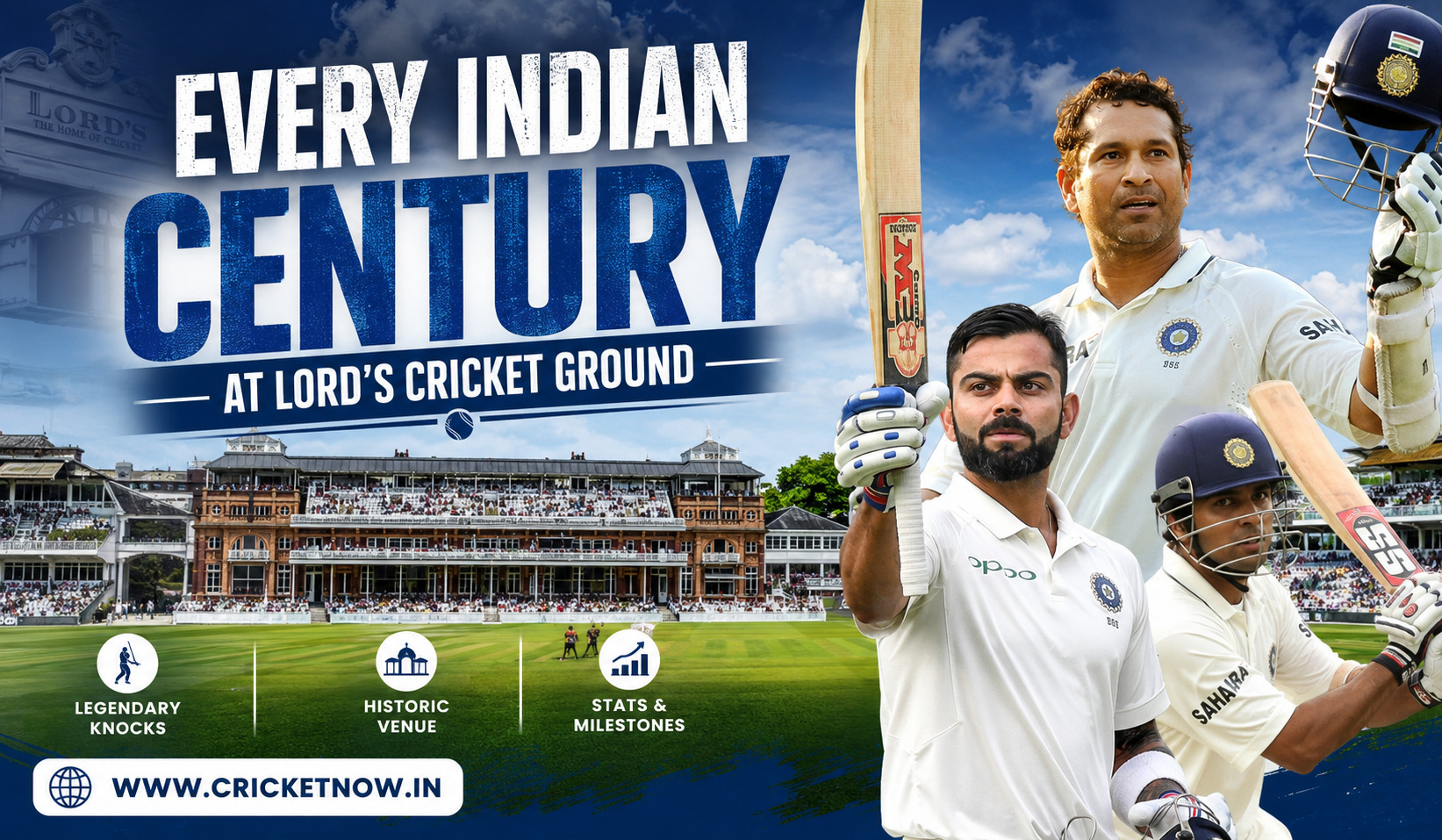
Only ten Indian batters have walked off the field at Lord’s with their name freshly painted on the honours board. That is ten centuries in roughly 86 years of Test cricket at the ground, a strike rate lower than almost anywhere else India has toured. This piece runs through every Indian century at Lord’s Cricket Ground, from Vinoo Mankad’s era-defining 184 in 1952 to Yastika Bhatia’s landmark hundred in 2026, and explains why this particular honour is so hard to earn.
What Makes a Century at Lord’s So Special
Lord’s is not just another venue on the fixture list. It is the ground where the laws of the game are still debated in committee rooms upstairs, and where the dressing rooms carry a physical record, painted wooden boards, of everyone who has scored a hundred or taken a five-wicket haul there. Getting your name up is permanent in a way a scorecard never quite feels.
The pitch itself has a reputation for doing just enough. The slope across the square, roughly eight feet from one side to the other, changes the way the ball seams and how bowlers set their length. Add in typically damp English summer mornings and a crowd that has seen every trick in the book, and it becomes clear why Indian centuries at Lord’s carry extra weight compared to hundreds scored elsewhere. Batters who fail here are not written off, but batters who succeed are remembered for decades.
That context matters when you look at the list below. Sachin Tendulkar, over more than two decades of Test cricket, never got a Lord’s hundred. Neither did Virat Kohli, despite being one of the most prolific run scorers of his generation. When a ground can deny two of India’s greatest batters, every name that does make the board deserves proper attention.
The Complete List: Every Indian Century at Lord’s
Here is the full chronological list of Indian batters who have scored a Test century at Lord’s, along with the year, the score, and how the match finished for India.
- Vinoo Mankad – 184 (1952) – Match lost
- Gundappa Vishwanath – 113 (1979) – Match drawn
- Dilip Vengsarkar – 103 (1979) – Match drawn
- Dilip Vengsarkar – 157 (1982) – Match lost
- Dilip Vengsarkar – 126 not out (1986) – Match won
- Ravi Shastri – 100 (1990) – Match lost
- Mohammad Azharuddin – 121 (1990) – Match lost
- Sourav Ganguly – 131 (1996) – Match drawn
- Ajit Agarkar – 109 not out (2002) – Match lost
- Rahul Dravid – 103 not out (2011) – Match lost
- Ajinkya Rahane – 103 (2014) – Match won
- KL Rahul – 129 (2021) – Match won
- KL Rahul – 100 (2025) – Match lost
- Yastika Bhatia – 113 (2026, Women’s Test) – Match won
Notice something odd in that list. Dilip Vengsarkar and KL Rahul are the only two Indians to score more than one hundred at the venue, and both of them managed it across separate tours rather than in a single Test. That kind of repeat success at Lord’s is rarer than a maiden century itself.
Vinoo Mankad’s 184: The One That Started It All
Before 1952, no Indian batter had ever reached three figures at the home of cricket. Vinoo Mankad changed that in the third Test of India’s tour, walking out and playing an innings of 184 that still stands as the highest score by an Indian at Lord’s, more than seven decades later.
The Innings Itself
India had been bowled out cheaply in earlier stages of that series, and Mankad’s innings came almost as a solo rescue act. He batted through fast bowling and spin alike, playing straight and punishing anything short, building an innings that helped India post 378 in that turn at the crease. The match still ended in a loss, but the performance is remembered independently of the result, the way a great solo goal is remembered even when the team loses the match.
Its Legacy
Mankad’s innings set a template. It told Indian batters visiting England that Lord’s was intimidating but not unbeatable. Every century that followed, in some small way, traces back to that afternoon in 1952, when an Indian all-rounder proved the ground could be conquered with patience and technique rather than pure luck.
Dilip Vengsarkar’s Historic Hat-Trick of Hundreds
If Mankad opened the door, Dilip Vengsarkar walked through it three separate times, a feat no other Indian batter has matched. His first century came in 1979, in a Test where India were skittled for 95 in the first innings before Vengsarkar and Vishwanath both scored hundreds in the second, dragging the total to 318 for 4 and turning a certain defeat into a draw.
Three years later, in 1982, Vengsarkar returned and made 157, coming in after India were forced to follow on. Then, in 1986, he completed the set with an unbeaten 126, helping India build a lead that eventually carried them to a five-wicket win, one of India’s rare Test victories at the ground.
What stands out about Vengsarkar’s record is not just the volume but the consistency. Scoring one hundred at a ground with a reputation for chewing up visiting batters is impressive. Doing it across three different tours, against different bowling attacks and in different match situations, is closer to owning the place. Fans still refer to him informally as the “Lord of Lord’s,” a nickname earned entirely on merit.
The Middle Years: From Shastri to Rahane
Between Vengsarkar’s final century in 1986 and the modern era, four more names went up on the honours board, each with its own story worth knowing.
- Ravi Shastri (1990) made exactly 100, anchoring an innings during a tour remembered more for England’s dominance than India’s batting, but his century remains a personal landmark in a career better known for his bowling all-round contributions.
- Mohammad Azharuddin (1990), in the same series, scored 121 with the elegant wristy stroke play that defined his career, though India still lost that Test comfortably.
- Sourav Ganguly (1996) produced a century, 131, on his Test debut at Lord’s, an achievement that instantly marked him as a batter with the technique and temperament to handle England’s conditions.
- Ajit Agarkar (2002), primarily known as a bowler, scored an unbeaten 109 while India were fighting to save the match, one of the more unlikely entries on this list and proof that the honours board does not care about a player’s usual role.
- Rahul Dravid (2011) made an unbeaten 103 in a losing cause, a reminder of just how reliable his technique remained even in the twilight of his Test career.
- Ajinkya Rahane (2014) scored 103 in a Test India actually won, part of a memorable series where India’s second Test victory at the ground finally arrived after a long wait.
Each of these innings adds a different flavour to the story, from a bowler stealing the show to a specialist batter grinding out a hundred under pressure.
KL Rahul and Yastika Bhatia: Lord’s Latest Chapters
The most recent era belongs to KL Rahul, who has now joined Vengsarkar as the only Indian to score multiple centuries at Lord’s. His first, an innings of 129 in 2021, came in a Test India went on to win, continuing a pattern of Rahul raising his game specifically for English conditions. His second century, a score of 100 in 2025, came in a losing effort but confirmed that his earlier hundred was no one-off; he had genuinely worked out the challenges the slope and the seam movement present.
Then, in July 2026, cricket at Lord’s opened a new chapter altogether. The ground hosted its first women’s Test featuring India, and Yastika Bhatia became the first Indian woman to have her name added to the honours board, scoring 113 in a winning effort for her side. It is the kind of moment that reshapes how a historic ground is remembered, expanding a list that had, for nearly a century, belonged only to men’s cricket.
Around the same period, Rohit Sharma also produced a hundred at Lord’s, though in the one-day format rather than a Test match, a different kind of milestone but a reminder that the ground continues to produce fresh Indian highlights even in 2026.
Why These Centuries Remain So Rare
Ten Test centuries in around 86 years is a small number for a country that has produced some of the finest batting talent in the sport’s history. A few factors explain the scarcity.
- The slope and seam movement make late swing genuinely difficult to counter, especially for batters who have grown up on flatter subcontinental surfaces.
- English weather adds inconsistent bounce and extra assistance for the ball, particularly in the first hour of a session.
- Small margins define these Tests, so batters often get one or two loose deliveries in an entire innings, and missing that chance can mean starting again from zero.
- Pressure of the occasion itself plays a part. Few venues carry the same psychological weight, and even experienced players have admitted to feeling it more than usual walking out at Lord’s.
Put simply, Lord’s does not reward good form alone. It rewards technique, patience, and a bit of good fortune, which is exactly why the list of names above reads like a shortlist of genuinely outstanding players rather than a routine record of runs scored.
FAQ: Indian Centuries at Lord’s
Who was the first Indian to score a century at Lord’s?
Vinoo Mankad holds that distinction, scoring 184 against England in 1952, an innings that also remains the highest individual score by an Indian at the ground.
Which Indian batter has scored the most centuries at Lord’s?
Dilip Vengsarkar and KL Rahul are tied at the top, each having scored two or more Test centuries at Lord’s. Vengsarkar’s three hundreds, spread across 1979, 1982, and 1986, remain unmatched by any other Indian batter.
Did Sachin Tendulkar or Virat Kohli ever score a century at Lord’s?
No. Despite long and prolific Test careers, neither Tendulkar nor Kohli managed a century at Lord’s, which is often cited as proof of how demanding the ground is regardless of a batter’s overall record.
Who was the first Indian woman to score a century at Lord’s?
Yastika Bhatia became the first Indian woman to have her name added to the Lord’s honours board, scoring 113 during India’s historic first women’s Test at the venue in July 2026.