

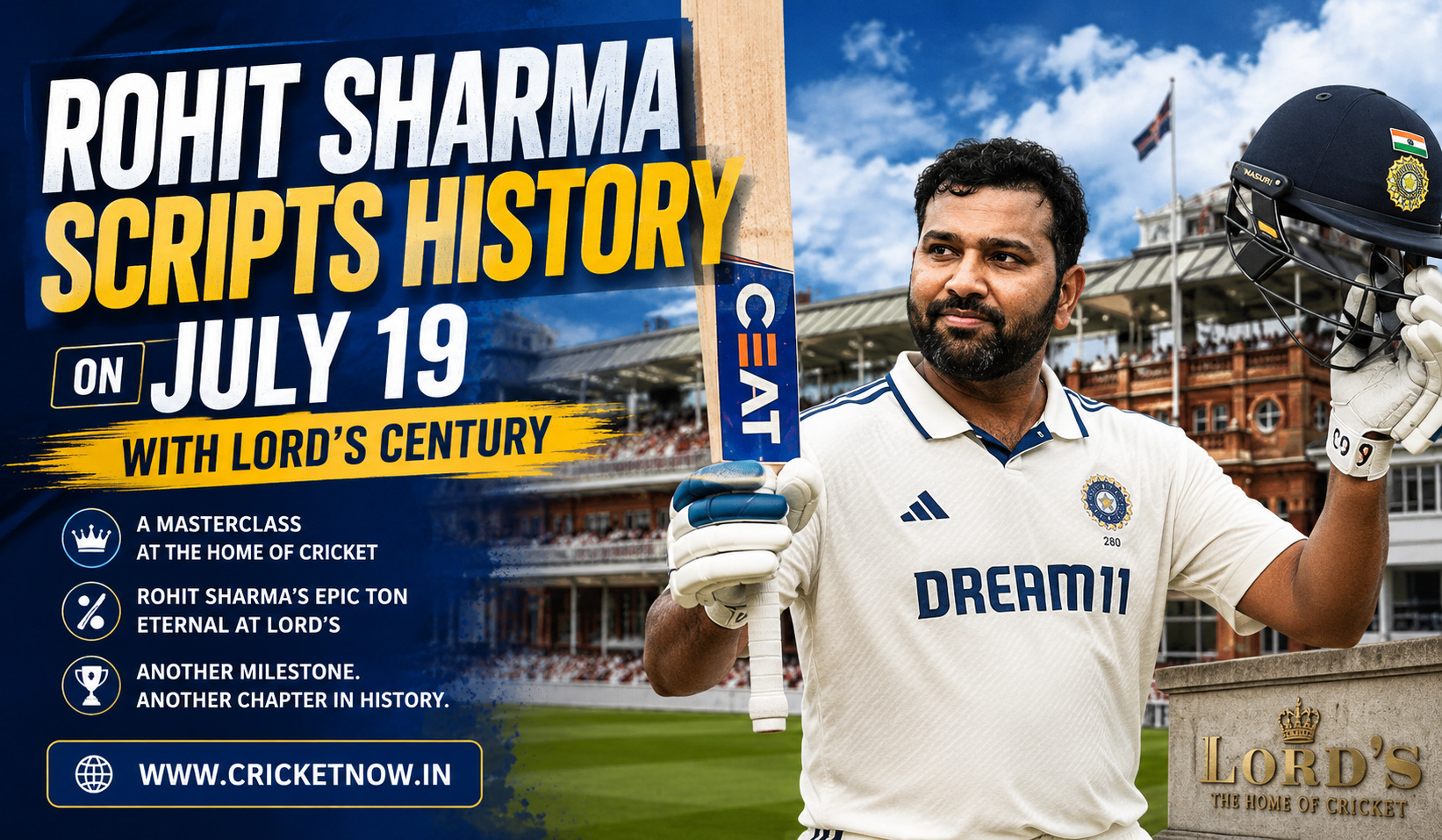
Two low scores, a mountain of retirement chatter, and a chase of 388 at the most famous ground in the sport. That is the exact situation Rohit Sharma walked into on July 19, 2026, and he answered every single question with a Rohit Sharma Lord’s century that instantly rewrote the Indian record books, even in a losing cause.
The Pressure Rohit Sharma Carried Into Lord’s
Coming into the third and final ODI of the series against England, the narrative around Rohit had stopped being about form and started being about finality. Scores of 11 and 26 in the first two matches of the series had done exactly what modest scores from a senior player always do, they turned every dot ball into a talking point and every cautious start into supposed proof that the end was near.
The BCCI had already gone on record dismissing suggestions that Lord’s would be his final ODI appearance, but denials from a cricket board rarely quiet the speculation on their own. At 39, with India’s build-up toward the 2027 ODI World Cup already underway, every innings Rohit played was being read as evidence for one side of the debate or the other. He needed a genuine statement, not just a start.
How the Lord’s Century Unfolded
Chasing a Record Target
England had set India a daunting 388 to win, built on a rampaging 192-run opening stand between Jacob Bethell and Ben Duckett that took the game away from India before it had properly started. A target that size at Lord’s is not the kind of number teams simply chase down through steady accumulation. It demanded urgency from ball one, and Rohit supplied exactly that.
He targeted pace bowler Josh Tongue in particular, at one stage dispatching him for consecutive sixes in a passage of play that swung momentum firmly back toward India. It is the kind of counter-punching Rohit built his reputation on, treating a record target the way a boxer treats an early knockdown, as a reason to attack rather than retreat.
The Gill Partnership
Rohit did not do this alone. He and opening partner Shubman Gill put together a fluent 147-run stand, the second-highest opening partnership by an Indian pair at Lord’s in ODI history. Gill contributed a composed 77 of his own, and the platform the pair built gave India a genuine chance of pulling off what would have been one of the great chases in the format.
Battling Cramps to Reach Three Figures
The physical toll of the innings became visible in its closing stages, with Rohit battling severe muscle cramps as he pushed past his century. He got there anyway, sweeping the ball powerfully through the gap at deep midwicket for a boundary that bounced once before crossing the rope, a fitting way to bring up a hundred that carried far more weight than the number itself suggested.
He eventually fell for 138 off just 84 balls, and walked off to a standing ovation from a crowd that understood exactly what they had just witnessed, regardless of which team they were supporting.
Records Broken at Lord’s
The scale of what Rohit achieved becomes clearer once you line up the numbers. Here is what this single innings added to his record sheet:
- First Indian batter to score an ODI century at Lord’s
- Third-fastest ODI hundred at Lord’s overall, behind only Jos Buttler’s 61 balls and Clive Lloyd’s 82 balls
- His 34th ODI century, and his first international hundred of 2026
- His eighth ODI century in England alone, the most by any visiting batter in a single country
- Only England’s Joe Root, with 10, has more ODI hundreds on English soil than Rohit, while Marcus Trescothick also sits on eight
There was even a small piece of trivia that went viral around the innings. Eagle-eyed fans on social media noticed Rohit was batting with a bat bearing Mumbai teammate Shardul Thakur’s name embossed near the bottom, not his usual equipment. Whatever the reason behind the swap, it clearly did the job at the home of cricket.
A Bittersweet Result for India
For all the individual brilliance, the team result did not go India’s way. The chase eventually broke down after Rohit’s dismissal, with India bowled out for 360, falling 27 runs short of England’s total. England sealed the three-match series 2-1, meaning Rohit’s finest innings of the year arrived in a defeat rather than a victory.
It is a familiar sporting irony. Compare it to a marathon runner producing a personal best time while still finishing second, the achievement does not shrink just because the scoreboard tells a different story. India will take plenty from the top-order form on show even as they process a series loss on English soil.
What This Century Means for Rohit’s ODI Future
The timing of this innings could not have been more pointed. Every conversation about Rohit’s ODI future over the past few weeks had centered on age and form, and he answered both in one afternoon. A 39-year-old opener producing his third-fastest century ever recorded at a famous venue, while battling cramps in the closing stages, is not the profile of a player whose powers are fading on schedule.
None of this guarantees a long runway toward the 2027 ODI World Cup. Selectors will still weigh workload, fitness, and form across the calendar rather than a single innings, however spectacular. But Rohit has bought himself something valuable: quiet, at least for now, on a question that had been following him into every net session and press conference.
Frequently Asked Questions
How many runs did Rohit Sharma score at Lord’s?
Rohit scored 138 runs off 84 balls in the third ODI against England at Lord’s on July 19, 2026.
Is this Rohit Sharma’s fastest ODI century?
No, it is not his fastest overall, but it is the third-fastest ODI century ever scored at Lord’s, behind only Jos Buttler and Clive Lloyd.
Did India win the match at Lord’s?
No. Despite Rohit’s century, India were bowled out for 360 while chasing 388, losing by 27 runs, and England won the series 2-1.
How many ODI centuries has Rohit Sharma scored in England?
This was his eighth ODI century in England, the most by any visiting batter in the country, behind only home favorite Joe Root’s 10.