

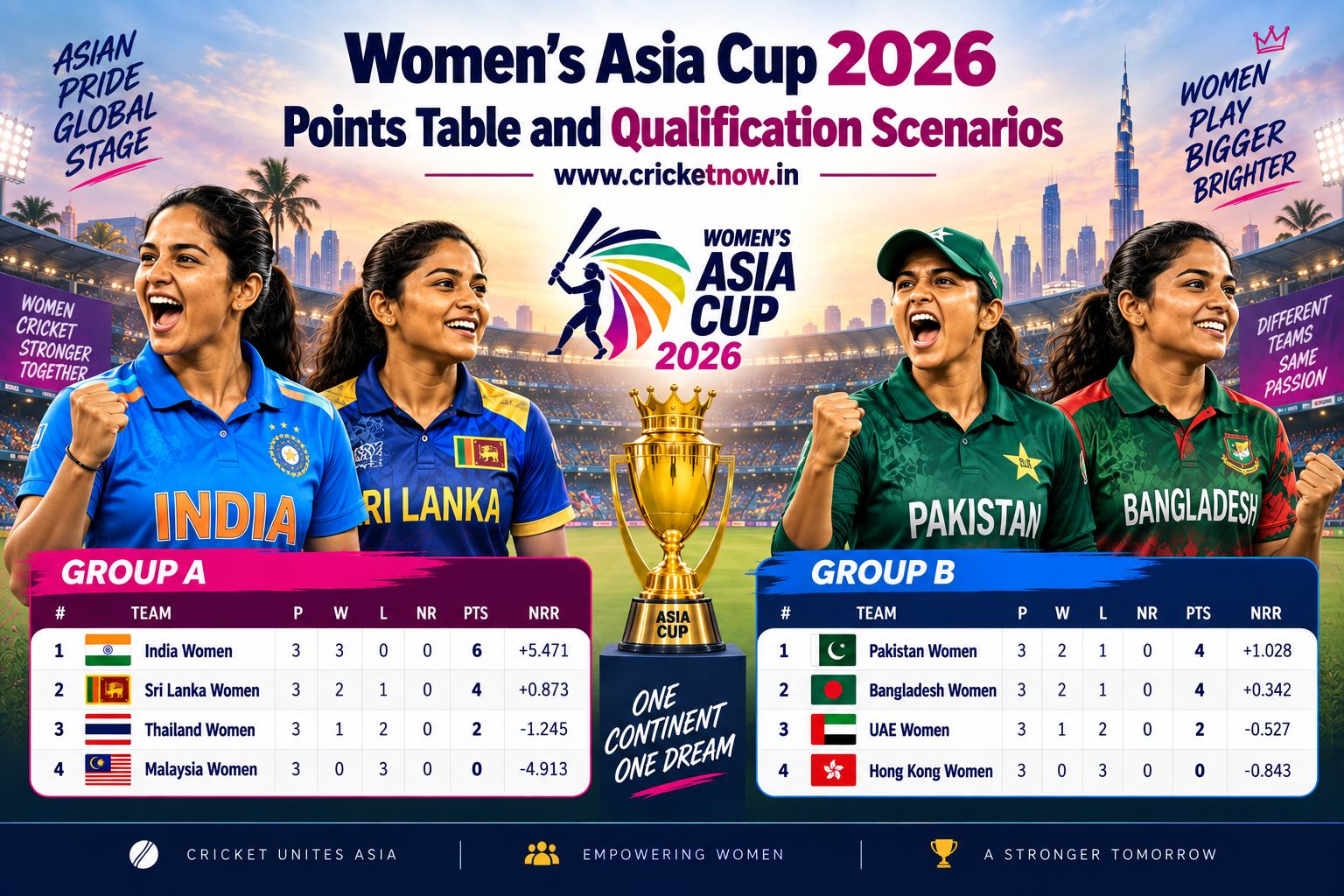
The Women’s Asia Cup 2026 group stage has produced a clear qualification picture, with India Women, Pakistan Women, Sri Lanka Women, and Bangladesh Women securing places in the next stage. India and Sri Lanka completed their group campaigns unbeaten, while Pakistan and Bangladesh finished second in their respective groups with two victories each. Thailand, Hong Kong Women, United Arab Emirates Women, and Indonesia Women could not finish inside the top two.
Group A Points Table
India Women finished first in Group A after winning all three of their matches. They collected six points from three games and recorded an impressive net run rate of +5.471. The unbeaten record gave India a perfect group-stage campaign, while the exceptionally strong NRR underlined the scale of their performances. Their first-place finish confirmed them as Group A leaders and secured their qualification.
Group A Standings
| Position | Team | P | W | L | NR | Pts | NRR |
|---|---|---|---|---|---|---|---|
| 1 | India Women (Q) | 3 | 3 | 0 | 0 | 6 | +5.471 |
| 2 | Pakistan Women (Q) | 3 | 2 | 1 | 0 | 4 | +0.927 |
| 3 | Thailand Women (E) | 3 | 1 | 2 | 0 | 2 | -2.050 |
| 4 | Hong Kong Women (E) | 3 | 0 | 3 | 0 | 0 | -3.583 |
Pakistan Women claimed second place in Group A with four points. They played three matches, winning two and losing one. Their net run rate stood at +0.927, which was also positive and reflected their ability to stay ahead of the other teams in the group. Pakistan’s two wins were enough to secure the second qualification position behind India.
Thailand Women finished third with two points. Their record included one win and two losses from three matches. They collected two points but could not close the gap on Pakistan, which finished four points ahead. Thailand’s NRR of -2.050 also shows that their overall results were not strong enough to challenge for a top-two position.
Hong Kong Women ended Group A in fourth place without a point. They lost all three matches and finished with a net run rate of -3.583. Their results meant that they were unable to enter the qualification race, and India and Pakistan eventually took the two available places from the group.
Group B Points Table
Sri Lanka Women topped Group B with a perfect record. They won all three matches, collected six points, and finished with a net run rate of +2.730. Although their NRR was lower than India’s, Sri Lanka’s three victories were enough to put them comfortably at the top of their group. Their unbeaten campaign confirmed their qualification as Group B leaders.
Group B Standings
| Position | Team | P | W | L | NR | Pts | NRR |
|---|---|---|---|---|---|---|---|
| 1 | Sri Lanka Women (Q) | 3 | 3 | 0 | 0 | 6 | +2.730 |
| 2 | Bangladesh Women (Q) | 3 | 2 | 1 | 0 | 4 | +1.688 |
| 3 | UAE Women (E) | 3 | 1 | 2 | 0 | 2 | -1.116 |
| 4 | Indonesia Women (E) | 3 | 0 | 3 | 0 | 0 | -3.169 |
Bangladesh Women finished second in Group B with four points. They won two of their three matches and lost one. Their net run rate was +1.688, giving them a positive performance figure alongside their four points. Bangladesh’s two victories placed them ahead of the teams below them and secured the second qualification position from Group B.
United Arab Emirates Women occupied third place after collecting two points from three matches. They recorded one win and two defeats, leaving them two points behind Bangladesh. Their net run rate of -1.116 was negative, which further separated them from the two qualifying teams. UAE showed the ability to win a match but could not produce enough consistent results to move into the top two.
Indonesia Women finished fourth in Group B with zero points. They lost all three matches and ended with a net run rate of -3.169. Because they could not record a victory, Indonesia had no opportunity to challenge Sri Lanka or Bangladesh for qualification.
How the Qualification Race Was Decided
The final qualification picture was determined by the positions in each group. The top two teams from Group A advanced, meaning India and Pakistan moved forward. In Group B, Sri Lanka and Bangladesh secured the available places from their group. The third- and fourth-placed teams in both groups were eliminated.
India’s three wins gave them the maximum six points available from their three group matches. Sri Lanka achieved the same total in Group B. Pakistan and Bangladesh each collected four points after winning two matches. Thailand and UAE earned two points apiece through one victory, while Hong Kong Women and Indonesia remained on zero.
The tables therefore provide a simple view of the qualification battle. Teams at the top collected enough points to move forward, while the teams below them could not maintain the required winning record.
Why Net Run Rate Matters
Net run rate, commonly abbreviated as NRR, provides an additional way of comparing teams. It considers the rate at which a team scores runs and the rate at which it concedes them across the matches used for calculation. In a short tournament, NRR can become especially important when teams finish level on points.
The Group A table illustrates the difference between the qualifying teams and those below them. India’s +5.471 was by far the strongest NRR in the group. Pakistan also finished with a positive +0.927. Thailand and Hong Kong Women recorded negative figures of -2.050 and -3.583 respectively.
Group B produced a similar pattern. Sri Lanka finished with +2.730 and Bangladesh with +1.688, while UAE recorded -1.116 and Indonesia -3.169. These numbers help explain the overall strength of the campaigns, although points and match results remained central to the final ranking.
Bangladesh Secures the Second Spot
Bangladesh completed the Group B qualification picture with four points. Their two wins and one defeat gave them a record similar to Pakistan’s in Group A. However, Bangladesh’s +1.688 NRR was notably positive, indicating that their successful results were supported by strong overall performance.
The second-place finish gave Bangladesh a chance to continue their tournament journey. Their qualification also meant Group B produced two teams with winning records, while UAE and Indonesia were unable to maintain the same level of consistency.
The Eliminated Teams
Thailand and UAE both finished their respective groups with two points. Each team won one match but lost two. Their positions demonstrate how difficult it can be to recover after multiple defeats in a short competition. One victory kept their campaigns alive temporarily, but two losses prevented them from reaching the required top-two position.
Hong Kong Women and Indonesia had even greater difficulty. Both teams finished without a win and therefore collected zero points. Hong Kong Women recorded an NRR of -3.583, while Indonesia ended at -3.169. Their campaigns show how quickly qualification hopes can disappear when a team cannot collect points.
What the Tables Reveal
The two points tables reveal a striking similarity between the groups. The winners, India and Sri Lanka, both finished with six points after unbeaten campaigns. The runners-up, Pakistan and Bangladesh, both finished with four points after winning two matches. The third-placed teams, Thailand and UAE, both ended on two points, while Hong Kong Women and Indonesia finished on zero.
This pattern makes the qualification structure easy to understand. Every group produced one unbeaten leader, one team with two wins, one team with one win, and one team without a victory. The standings therefore reflect a clear progression based on match results.
The Importance of Consistency
Consistency was the biggest factor separating the qualified teams from the eliminated sides. India and Sri Lanka won every match, while Pakistan and Bangladesh won enough games to secure second place. Thailand and UAE showed that a single victory was not sufficient, and Hong Kong Women and Indonesia could not collect any points.
In a tournament featuring a limited number of matches, teams have very little time to recover from mistakes. A defeat can immediately increase pressure on the remaining fixtures. The final tables demonstrate that teams capable of maintaining momentum throughout the group stage were rewarded with qualification.
Final Qualification Picture
The completed tables confirm four qualified teams: India and Pakistan from Group A, and Sri Lanka and Bangladesh from Group B. India and Sri Lanka topped their groups with six points each, while Pakistan and Bangladesh followed with four points each.
Thailand, Hong Kong Women, UAE, and Indonesia finished outside the qualifying positions. Thailand and UAE collected two points apiece, while Hong Kong Women and Indonesia ended with none. Their results underline the importance of converting opportunities into victories during the league phase.
The group standings also created the knockout matchups. The Group A winner faced the Group B runner-up, while the Group B winner faced the Group A runner-up. This meant India were paired with Bangladesh, while Sri Lanka met Pakistan in the other semi-final. The structure rewarded the teams that finished first while ensuring that sides from the same group did not immediately meet again.
Conclusion
The Women’s Asia Cup 2026 points table presents a clear story of successful group-stage campaigns and the importance of consistency. India led Group A with three wins, six points, and an outstanding +5.471 NRR. Pakistan followed with four points and a +0.927 NRR. In Group B, Sri Lanka matched India’s six points through three wins and recorded +2.730, while Bangladesh finished second with four points and +1.688.
The qualification scenarios ultimately became straightforward because the top two teams in each group separated themselves through victories. India, Pakistan, Sri Lanka, and Bangladesh earned their places in the next stage, while Thailand, Hong Kong Women, UAE, and Indonesia were eliminated. Beyond the numbers, the tables highlight a central lesson of tournament cricket: every match matters, every win adds valuable points, and strong overall performances can provide an important advantage when qualification pressure increases.